Sodium Stannate Trihydrate
Modify Date: 2025-10-11 12:10:42
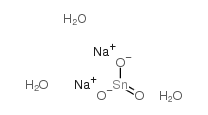
Sodium Stannate Trihydrate structure
|
Common Name | Sodium Stannate Trihydrate | ||
|---|---|---|---|---|
| CAS Number | 12209-98-2 | Molecular Weight | 266.72500 | |
| Density | N/A | Boiling Point | N/A | |
| Molecular Formula | H6Na2O6Sn | Melting Point | 140°C (dec.) | |
| MSDS | Chinese USA | Flash Point | N/A | |
| Name | dioxotin,sodium,trihydrate |
|---|---|
| Synonym | More Synonyms |
| Melting Point | 140°C (dec.) |
|---|---|
| Molecular Formula | H6Na2O6Sn |
| Molecular Weight | 266.72500 |
| Exact Mass | 267.89800 |
| PSA | 90.88000 |
| InChIKey | SFXJSNATBHJIDS-UHFFFAOYSA-N |
| SMILES | O.O.O.O=[Sn]([O-])[O-].[Na+].[Na+] |
| Storage condition | Store at RT. |
|
Section 1: Product Identification Chemical Name:Sodium stannate trihydrate, min. 95% CAS Registry Number:12209-98-2 Formula:Na2SnO3.3H2O EINECS Number:none Chemical Family:inorganic compound Synonym:none
Section 2: Composition and Information on Ingredients IngredientCAS NumberPercentACGIH (TWA)OSHA (PEL) Title Compound12209-98-2100%2mg/m3 (as Sn)2mg/m3 (as Sn) Section 3: Hazards Identification Emergency Overview:Irritating to eyes, skin and respiratory tract. May be harmful if swallowed Primary Routes of Exposure:Ingestion, inhalation Eye Contact:Causes slight to mild irritation of the eyes. Skin Contact:Causes slight to mild irritation of the skin. Inhalation:Irritating to the nose, mucous membranes and respiratory tract. Ingestion:No information on the physiological effects of ingestion. Acute Health Affects:Irritating to skin, eyes and respiratory tract. Chronic Health Affects:Prolonged exposure to dust of tin compounds may result in benign pneumoconiosis. NTP:No IARC:No OSHA:No SECTION 4: First Aid Measures Immediately flush the eyes with copious amounts of water for at least 10-15 minutes. A victim may need Eye Exposure: assistance in keeping their eye lids open. Get immediate medical attention. Wash the affected area with water. Remove contaminated clothes if necessary. Seek medical assistance if Skin Exposure: irritation persists. Remove the victim to fresh air. Closely monitor the victim for signs of respiratory problems, such as difficulty Inhalation: in breathing, coughing, wheezing, or pain. In such cases seek immediate medical assistance. Seek medical attention immediately. Keep the victim calm. Give the victim water (only if conscious). Induce Ingestion: vomiting only if directed by medical personnel. SECTION 5: Fire Fighting Measures Flash Point:not applicable Autoignition Temperature:none Explosion Limits:none Extinguishing Medium:none required If involved in a fire, fire fighters should be equipped with a NIOSH approved positive pressure self-contained Special Fire Fighting Procedures: breathing apparatus and full protective clothing. Hazardous Combustion andNone Decomposion Products: Unusual Fire or Explosion Hazards: No unusual fire or explosion hazards. SECTION 6: Accidental Release Measures Spill and Leak Procedures:Small spills can be mixed with powdered sodium carbonate or ground limestone and swept up. SECTION 7: Handling and Storage Handling and Storage:Store material in a tightly sealed bottle away from moisture. SECTION 8: Exposure Controls and Personal Protection Eye Protection:Always wear approved safety glasses when handling a chemical substance in the laboratory. Skin Protection:Wear appropriate chemical resistant gloves and protective clothing. Ventilation:If possible, handle the material in an efficient fume hood. In the absence of adequate ventilation a respirator should be worn. The use of a respiratory requires a Respirator: Respirator Protection Program to be in compliance with 29 CFR 1910.134. Ventilation:If possible, handle the material in an efficient fume hood. Additional Protection:No additional protection required. SECTION 9: Physical and Chemical Properties Color and Form:white pwdr. Molecular Weight:212.68 (266.71) Melting Point:no data Boiling Point:no data Vapor Pressure:no data Specific Gravity:no data Odor:none Solubility in Water:Soluble SECTION 10: Stability and Reactivity Stability:air and moisture stable Hazardous Polymerization:no hazardous polymerization Conditions to Avoid:none Incompatibility:Active metals Decomposition Products:none SECTION 11: Toxicological Information RTECS Data:No information available in the RTECS files. Carcinogenic Effects:no data Mutagenic Effects:no data Tetratogenic Effects:no data SECTION 12: Ecological Information Ecological Information:No information available SECTION 13: Disposal Considerations Disposal:Dispose of according to local, state and federal regulations. SECTION 14: Transportation Shipping Name (CFR):Non-hazardous Hazard Class (CFR):NA Additional Hazard Class (CFR):NA Packaging Group (CFR):NA UN ID Number (CFR):NA Shipping Name (IATA):Non-hazardous Hazard Class (IATA):NA Additional Hazard Class (IATA):NA Packaging Group (IATA):NA UN ID Number (IATA):NA SECTION 15: Regulatory Information TSCA:Not listed in the TSCA inventory. SARA (Title 313):Title compound not listed Second Ingredient:none SECTION 16 - ADDITIONAL INFORMATION N/A |
| Personal Protective Equipment | Eyeshields;Gloves;type N95 (US);type P1 (EN143) respirator filter |
|---|---|
| Hazard Codes | Xn |
| Safety Phrases | S22-S24/25 |
| RIDADR | NONH for all modes of transport |
| WGK Germany | 3 |
| HS Code | 2841900090 |
| HS Code | 2841900090 |
|---|
| MFCD00150189 |
| EINECS 235-030-5 |
| Stannate (SnO32-),disodium,trihydrate (9CI) |
| Sodium tin(IV) oxide trihydrate |
| Sodium stannate hydrate |
| Sodium Stannate Trihydrate |
The content on this webpage is sourced from various professional data sources. If you have any questions or concerns regarding the content, please feel free to contact service1@chemsrc.com.
- Shanghai Nianxing Industrial Co., Ltd
- China
- Product Name: Sodium Stannate Trihydrate
- Price: Check
- Purity: 98.0%
- Delivery: 10 Day
- Contact: Yang
- Email: sales@echemcloud.com
- Shanghai Jizhi Biochemical Technology Co., Ltd
- China
- Product Name: Sodium Stannate Trihydrate
- Price: ¥168.0/500g
- Purity: 98.0%
- Delivery: 3 Day
- Contact: Liu jia


- Email: 2130147988@qq.com
- Dayang Chem (Hangzhou) Co., Ltd.
- China
- Product Name: Stannate (SnO32-), disodium, trihydrate (9CI)
- Price: $Inquiry/100g $Inquiry/1kg $Inquiry/100kg $Inquiry/1000kg
- Purity: 98.0%
- Delivery: Inquiry
- Contact: Ms Wang
- Email: enquiry@dycnchem.com
- Henan Tianfu Chemical Co., Ltd.
- China
- Product Name: Sodium stannate trihydrate, min. 95%
- Price: $Inquiry/1kg $Inquiry/25kg $Inquiry/1000kg $Inquiry/10ton
- Purity: 99.0%
- Delivery: Inquiry
- Contact: Anson
- Email: info@tianfuchem.com
- Zhongshan Xingrui Chemical Co. , Ltd.
- China
- Product Name: Sodium Stannate Trihydrate
- Price: ¥Inquiry/1kg ¥Inquiry/25kg ¥Inquiry/200kg
- Purity: 42.0%
- Delivery: 3 Day
- Contact: Wang Jie
- Email: 3096638339@qq.com
Get all suppliers and price by the below link: