Isopropyl unoprostone
Modify Date: 2025-08-31 18:04:50
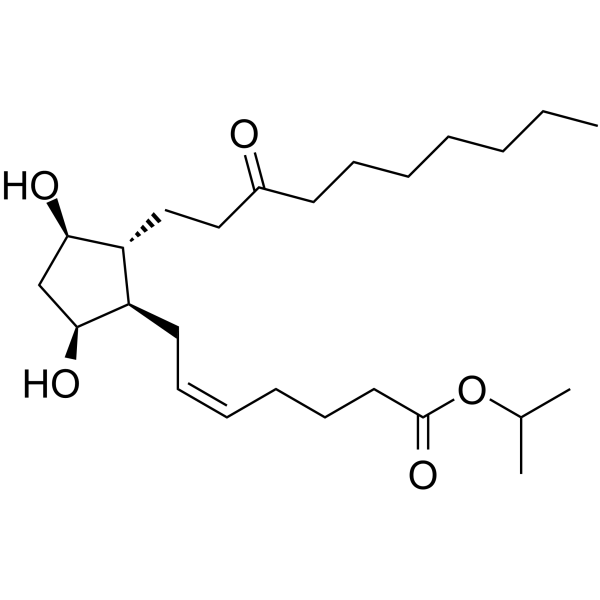
Isopropyl unoprostone structure
|
Common Name | Isopropyl unoprostone | ||
|---|---|---|---|---|
| CAS Number | 120373-24-2 | Molecular Weight | 424.614 | |
| Density | 1.0±0.1 g/cm3 | Boiling Point | 546.3±45.0 °C at 760 mmHg | |
| Molecular Formula | C25H44O5 | Melting Point | N/A | |
| MSDS | N/A | Flash Point | 172.2±22.2 °C | |
Use of Isopropyl unoprostoneIsopropyl unoprostone (Unoprostone isopropyl ester), an analogue of a prostaglandin metabolite, is a potent large conductance Ca2+-activated K+ (BK) channels activator. Isopropyl unoprostone has antiglaucoma effects, lowering intraocular pressure (IOP) by increasing aqueous humour outflow. Isopropyl unoprostone can improve retinal sensitivity and the protection of central retinal sensitivity[1][2]. |
| Name | isopropyl unoprostone |
|---|---|
| Synonym | More Synonyms |
| Description | Isopropyl unoprostone (Unoprostone isopropyl ester), an analogue of a prostaglandin metabolite, is a potent large conductance Ca2+-activated K+ (BK) channels activator. Isopropyl unoprostone has antiglaucoma effects, lowering intraocular pressure (IOP) by increasing aqueous humour outflow. Isopropyl unoprostone can improve retinal sensitivity and the protection of central retinal sensitivity[1][2]. |
|---|---|
| Related Catalog | |
| Target |
BK channels[1] |
| In Vitro | Isopropyl unoprostone (0.01-1 μM; 24 h) protects against H2O2-induced 661W cell death[2]. Isopropyl unoprostone (0.1-3 μM; 24 h) reduced the morphological change of 661W cells and protects against light-induced cell death[2]. Isopropyl unoprostone (0.001-1 μM; 48 h) suppresses light-induced phagocytotic dysfunction in ARPE-19 cells[2]. Apoptosis Analysis[2] Cell Line: 661W (treated with Isopropyl unoprostone for 1 h, then added H2O2) Concentration: 0.01, 0.1 and 1 μM Incubation Time: 24 h Result: Protected against H2O2-induced cell death in a concentration-dependent manner. Apoptosis Analysis[2] Cell Line: 661W (treated with Isopropyl unoprostone for 1 h, then exposed to 2,500 lux of white fluorescent light) Concentration: 0.1, 1 and 3 μM Incubation Time: 24 h Result: Protected against light-induced cell death in a concentration-dependent manner, and the effect was significant at the 1 and 3 μM concentrations; reduced the morphological change (the transition to a rounder shape) which is potentially indicative of a pre-apoptotic stage. |
| References |
| Density | 1.0±0.1 g/cm3 |
|---|---|
| Boiling Point | 546.3±45.0 °C at 760 mmHg |
| Molecular Formula | C25H44O5 |
| Molecular Weight | 424.614 |
| Flash Point | 172.2±22.2 °C |
| Exact Mass | 424.318878 |
| PSA | 83.83000 |
| LogP | 4.63 |
| Vapour Pressure | 0.0±3.3 mmHg at 25°C |
| Index of Refraction | 1.492 |
| Storage condition | -20°C Freezer |
| MFCD00886951 |
| Unoprostone Isopropyl |
| Isopropyl (5Z)-7-[(1R,2R,3R,5S)-3,5-dihydroxy-2-(3-oxodecyl)cyclopentyl]-5-heptenoate |
| 5-Heptenoic acid, 7-((1R,2R,3R,5S)-3,5-dihydroxy-2-(3-oxodecyl)cyclopentyl)-, 1-methylethyl ester, (5Z)- |
| Unoprostone Isopropyl Ester |
| Isopropyl (5Z)-7-[(1R,2R,3R,5S)-3,5-dihydroxy-2-(3-oxodecyl)cyclopentyl]hept-5-enoate (non-preferred name) |
| Isopropyl unoprostone |