54063-53-5
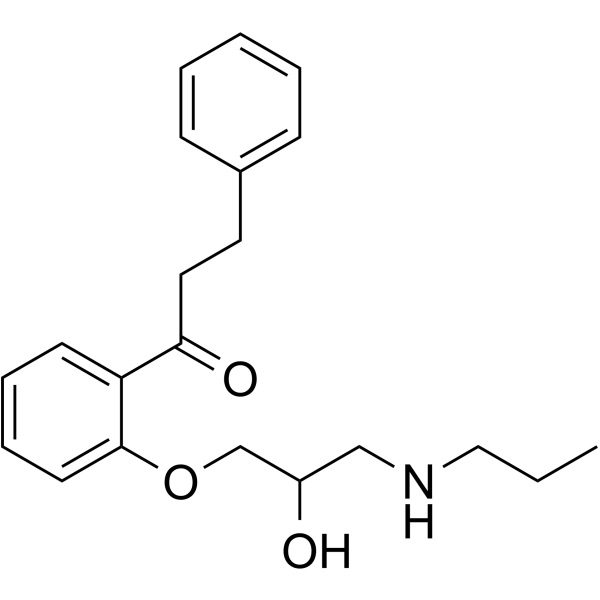
54063-53-5 structure
- Name: Propafenone
- Chemical Name: propafenone
- CAS Number: 54063-53-5
- Molecular Formula: C21H27NO3
- Molecular Weight: 341.44400
- Catalog: API Circulatory system medication Antiarrhythmic drug
- Create Date: 2018-03-30 08:00:00
- Modify Date: 2026-06-30 09:47:20
-
Propafenone (SA-79), a sodium-channel blocker, acts an antiarrhythmic agent. Propafenone also has high affinity for the β receptor (IC50=32 nM)[1]. Propafenone blocks the transient outward current (Ito) and the sustained delayed rectifier K current (Isus) with IC50 values of 4.9 μm and 8.6 μm, respectively[2]. Propafenone suppresses esophageal cancer proliferation through inducing mitochondrial dysfunction and induce apoptosis[3].
| Name | propafenone |
|---|---|
| Synonyms |
EINECS 258-955-6
WZ-884-643 WZ-884-642 5-OH-Propafenone-D5 Propafenone PROPAFENONE HCL USP MFCD00216020 |
| Description | Propafenone (SA-79), a sodium-channel blocker, acts an antiarrhythmic agent. Propafenone also has high affinity for the β receptor (IC50=32 nM)[1]. Propafenone blocks the transient outward current (Ito) and the sustained delayed rectifier K current (Isus) with IC50 values of 4.9 μm and 8.6 μm, respectively[2]. Propafenone suppresses esophageal cancer proliferation through inducing mitochondrial dysfunction and induce apoptosis[3]. |
|---|---|
| Related Catalog | |
| In Vitro | Propafenone (5-25 μM) inhibits esophageal squamous cell carcinoma (ESCC) cell proliferation[3]. Propafenone causes mitochondrial dysfunction by a decreased mitochondrial membrane potential and reduced expression of Bcl-xL and Bcl-2[3]. Propafenone (10 and 20 μm) treatment significantly down regulates the expression levels of the anti-apoptotic proteins Bcl-xL and Bcl-2 in ESCC cells. Propafenone also reduces expression of p-ERK[3]. Cell Proliferation Assay[3] Cell Line: The human ESCC cell lines KYSE30, KYSE150 and KYSE270 Concentration: 5, 10, 15, 20, and 25 μm Incubation Time: 24, 48, and 72 hours Result: Gradually decreased cell proliferation over time and potently inhibited cell proliferation with increasing concentrations in KYSE30, KYSE150 and KYSE270 cells. Western Blot Analysis[3] Cell Line: The human ESCC cell lines KYSE30, KYSE150 and KYSE270 Concentration: 0, 10, and 20 μm Incubation Time: 72 hours Result: Significant downregulation of Bcl-xL and Bcl-2 expression levels was observed. |
| In Vivo | Propafenone (20 mg/kg; intraperitoneal injection every other day) markedly suppresses the tumor burden with a decrease of 69.2%[3]. Propafenone also significantly inhibits tumor cell proliferation (mean index decreased from 56.3±6.7% in the DMSO-treated group to 20.7±5.1% in the 10 mg/kg propafenone-treated group and 11.3±4.0% in the 20 mg/kg propafenone-treated group)[3]. Animal Model: Female BALB/c nude mice bearing KYSE270-derived xenografts (6-8 weeks)[3] Dosage: 10 mg/kg or 20 mg/kg Administration: Intraperitoneally injected Result: Exerted a significantly inhibitory effect on the growth of tumor xenografts. |
| References |
| Density | 1.096 g/cm3 |
|---|---|
| Melting Point | 171 - 174ºC |
| Molecular Formula | C21H27NO3 |
| Molecular Weight | 341.44400 |
| Flash Point | 268ºC |
| Exact Mass | 341.19900 |
| PSA | 58.56000 |
| LogP | 3.63230 |
| Index of Refraction | 1.557 |
| Storage condition | 2-8°C |
CHEMICAL IDENTIFICATION
HEALTH HAZARD DATAACUTE TOXICITY DATA
|
| Hazard Codes | T |
|---|---|
| Risk Phrases | R46 |
| Safety Phrases | 53-36/37/39-45 |
| WGK Germany | 3 |
| RTECS | UH2833000 |