34633-34-6
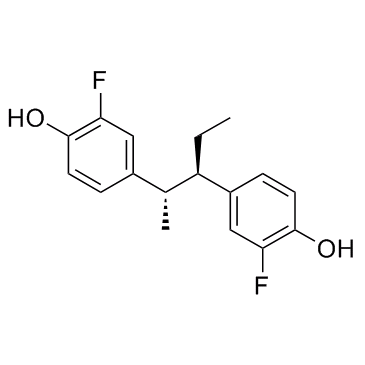
34633-34-6 structure
- Name: BX341
- Chemical Name: 2-fluoro-4-[3-(3-fluoro-4-hydroxyphenyl)pentan-2-yl]phenol
- CAS Number: 34633-34-6
- Molecular Formula: C17H18F2O2
- Molecular Weight: 292.32000
- Catalog: Research Areas Metabolic Disease
- Create Date: 2016-08-03 06:25:43
- Modify Date: 2026-07-17 12:02:21
-
BX341 is an anti-androgen.
| Name | 2-fluoro-4-[3-(3-fluoro-4-hydroxyphenyl)pentan-2-yl]phenol |
|---|---|
| Synonyms |
erythro-2,3-Bis(3-fluor-4-hydroxyphenyl)pentan
Bifluranolum Bifluranolum [INN-Latin] BX-341 Bifluranol BX341 |
| Description | BX341 is an anti-androgen. |
|---|---|
| Related Catalog | |
| Target |
Androgen Receptor[1] |
| In Vivo | The absorption, distribution and excretion of BX341 (Bifluranol) have been studied in mouse, rat, ferret and dog; BX341is readily absorbed following oral administration, but blood concentrations of BX341 are low due to hepatic uptake and biliary excretion. After intravenous administration of [3H] BX341 to rats (200 μg/kg) and ferrets (60 μg/kg) the blood concentrations of 3H decreases rapidly for the first 2 to 3 h, with the decrease being more rapid in females ( 18 min for rat, 30 min for ferret) than males (1.0 h for rat, 1.4 h for ferret). This is followed by a much slower decline (40 h for rat, 20 h for ferret) to concentrations at 96 h of less than 15 ng BX341 equivalents mL-1 (rat) or 1 ng BX341 equivalents mL-1 (ferret)[1]. |
| Animal Admin | Mice, Rats, Dogs and Ferrets[1] Swiss albino mice (24-28 g, males age 4 weeks, females age 6 weeks; pregnant mice mated at 6 weeks, used at day 18 of pregnancy) and Wistar albino rats (200 g males age 6 weeks, females age 8 weeks; 350 g males age 10 weeks) are fed Dixon's mouse and rat diet and have free access to water. Albino ferrets (0.7-2.6 kg, age 9-15 months) are fed raw meat, bread and milk. Male beagles (10.8-12.3 kg, age 10-14 years) are fed Spratt's complete dog diet. [3H] BX341 administration is by intragastric intubation, in propylene glycol (mouse 0.1 ml, rat 0.1-0.2 mL, ferret 0.1-0.4 mL and dog 1 mL), except for the dog 96 h excretion study when the drug is absorbed onto starch and given in a gelatin capsule. BX341 is given intravenously in propylene glycol-0.9% NaCl (saline) (1 : 1 v/v) (0.1-0.2 mL), via a tail vein in mice and rats and the jugular vein in ferrets (under ether anaesthesia). [3H] BX341 (2 mg/kg, 1.1 mCi) is administered orally or intravenously to male, female and pregnant mice. After various time intervals they are killed under ether anaesthesia by immersion in solid CO2-hexane (-70°C). The tail, limbs and ears are removed. The animals shaved, embedded and frozen in 5 % aq. acacia wax. The animal blocks are cut using a Slee whole-body freezing microtome to obtain lateral sections (30 pm) which are exposed to X-ray film at 4°C and the auto-radiograms examined after 1,3 or 6 months. [3H]Bifluranol is adrninistered orally or intravenously to rats (200 μg/kg, 0.86-1.0 mCi) , ferrets (60 μg/kg, 5.0-10.6 mCi) and orally only to dogs (50 μg/kg, 70-76 mCi) . Blood samples (10-100 μL) are taken for radioactivity determination at time intervals up to 96 h (rat and ferret) or 6 h (dog). |
| References |
| Density | 1.221g/cm3 |
|---|---|
| Boiling Point | 361.6ºC at 760mmHg |
| Molecular Formula | C17H18F2O2 |
| Molecular Weight | 292.32000 |
| Flash Point | 172.5ºC |
| Exact Mass | 292.12700 |
| PSA | 40.46000 |
| LogP | 4.67330 |
| Index of Refraction | 1.565 |