923978-27-2
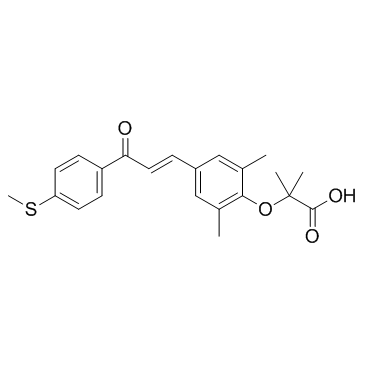
923978-27-2 structure
- Name: Elafibranor
- Chemical Name: (E)-Elafibranor
- CAS Number: 923978-27-2
- Molecular Formula: C22H24O4S
- Molecular Weight: 384.489
- Catalog: Organic raw materials Carboxylic compounds and derivatives Halogenation, sulfonation, nitration or nitration of carboxylic anhydrides
- Create Date: 2018-04-25 05:52:27
- Modify Date: 2026-07-02 12:26:02
-
Elafibranor is a PPARα/δ agonist with EC50s of 45 and 175 nM, respectively.
| Name | (E)-Elafibranor |
|---|---|
| Synonyms |
UNII-2J3H5C81A5
2-(2,6-Dimethyl-4-{(1E)-3-[4-(methylsulfanyl)phenyl]-3-oxo-1-propen-1-yl}phenoxy)-2-methylpropanoic acid GFT505 Elafibranor 2-[2,6-Dimethyl-4-[(1E)-3-[4-(methylthio)phenyl]-3-oxo-1-propen-1-yl]phenoxy]-2-methylpropanoic acid |
| Description | Elafibranor is a PPARα/δ agonist with EC50s of 45 and 175 nM, respectively. |
|---|---|
| Related Catalog | |
| Target |
PPAR-α:45 nM (EC50) PPAR-δ:175 nM (EC50) |
| In Vitro | GFT505 is being developed as a dual PPAR-α/PPAR-δ agonist for the treatment of T2DM and non-alcoholic fatty liver disease. GFT505 has an active metabolite, GFT1007, and both have potent agonist activity for PPAR-α and to a lesser extent for PPAR-δ[1]. |
| In Vivo | GFT505 improves insulin sensitivity and early studies indicate it may be useful in non-alcoholic fatty liver disease which is being tested in a Phase IIb study[1]. Elafibranor is well tolerated and does not cause weight gain or cardiac events, but does produce a mild, reversible increase in serum creatinine. Elafibranor improves insulin sensitivity, glucose homeostasis, and lipid metabolism and reduces inflammation[2]. GFT505 treatment improves glucose control and plasma lipids in diabetic db/db mice. A significant dose-dependent reduction of hepatic expression of the key gluconeogenic enzymes glucose 6-phosphatase (G6Pase), PEPCK, and fructose 1,6-bisphosphatase 1 (FBP1) is observed with GFT505. GFT505 does not induce cardiac adverse effects of PPARγ-activating agonists in monkeys[3]. |
| References |
| Density | 1.2±0.1 g/cm3 |
|---|---|
| Boiling Point | 569.0±50.0 °C at 760 mmHg |
| Molecular Formula | C22H24O4S |
| Molecular Weight | 384.489 |
| Flash Point | 297.9±30.1 °C |
| Exact Mass | 384.139526 |
| LogP | 5.63 |
| Vapour Pressure | 0.0±1.6 mmHg at 25°C |
| Index of Refraction | 1.606 |
| Storage condition | 2-8°C |