Daclatasvir (BMS-790052)
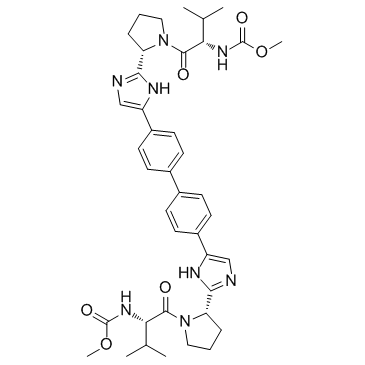
Daclatasvir (BMS-790052) structure
|
Common Name | Daclatasvir (BMS-790052) | ||
|---|---|---|---|---|
| CAS Number | 1009119-64-5 | Molecular Weight | 738.875 | |
| Density | 1.3±0.1 g/cm3 | Boiling Point | 1071.2±65.0 °C at 760 mmHg | |
| Molecular Formula | C40H50N8O6 | Melting Point | N/A | |
| MSDS | N/A | Flash Point | 601.7±34.3 °C | |
Use of Daclatasvir (BMS-790052)Daclatasvir is a potent HCV NS5A protein inhibitor, with mean EC50 values of 50 and 9 pM against genotype 1a and 1b replicons, respectively. |
This table lists Chinese names, IUPAC names and various aliases of this chemical substance.
| Name | daclatasvir |
|---|---|
| Synonym | More Synonyms |
This table contains bioactivity, target information and biological‑assay experimental data of this compound.
| Description | Daclatasvir is a potent HCV NS5A protein inhibitor, with mean EC50 values of 50 and 9 pM against genotype 1a and 1b replicons, respectively. |
|---|---|
| Related Catalog | |
| Target |
EC50: 9±4 pM (HCV replicon genotype 1b, in Con1 cells), 50 ± 13 pM (HCV replicon genotype 1a, in H77 cells)[1] |
| In Vitro | Daclatasvir (BMS-790052) is a small molecule inhibitor of the HCV NS5A protein that exhibits picomolar half-maximum effective concentrations (EC50) towards replicons expressing a broad range of HCV genotypes and the JFH-1 genotype 2a infectious virus in cell culture. Daclatasvir is a potent inhibitor of the JFH-1 genotype 2a infectious virus that replicates in cell culture (EC50=28 pM), an assay considered to be a more biologically relevant in vitro cell culture system. In addition, Daclatasvir displays similar potency in Huh-7, HeLa and HEK293T cells, demonstrating that the function(s) of NS5A inhibited by Daclatasvir is (are) highly conserved in different cellular environments[1]. |
| In Vivo | In a randomized, double-blind, placebo-controlled, single ascending-dose study, Daclatasvir (BMS-790052) is administered at six dose levels to healthy, non-HCV-infected subjects over a range of 1 to 200 mg as an oral solution. Daclatasvir is safe and well tolerated up to 200 mg with no clinically relevant adverse effects. After oral administration, Daclatasvir is readily absorbed, with dose-proportional exposures over the studied dose range, and all subjects have drug concentrations greater than the protein-binding-adjusted EC90 for genotypes 1a and 1b, as measured in the replicon assay, at and beyond 24 h post-dose. (The protein binding-adjusted EC90 figures are derived from an analysis of the effect of the addition of human serum on antiviral activity in replicons. In the presence of 40% human serum, the EC90 for Daclatasvir is 383 pM (0.28 ng/mL) for the genotype 1a replicon and 49 pM (0.04 ng/mL) for the genotyope 1b replicon)[1]. Mice in each group that developed persistent HCV infection are divided into two treatment groups. One group receive 4 weeks of Asunaprevir/Daclatasvir treatment and the other group received 4 weeks of Ledipasvir/GS-558093 treatment. Asunaprevir/Daclatasvir therapy and Ledipasvir/GS-558093 therapy rapidly decease serum HCV RNA levels to below the sensitivity, and they are not detected after completion of the therapy except for two mice in the Ledipasvir/GS-558093 group[2]. |
| Cell Assay | HCV genotype 1a and 1b replicon cells are maintained in media containing Daclatasvir at a concentration of 5- to 20-fold above EC50 and 0.5 mg/mL G418. Replicon cells similarly treated with DMSO are maintained as controls. After approximately 4-5 weeks when cell growth is similar to DMSO-treated control cells, selected cells are expanded for resistance testing and analysis by PCR with reverse transcription[1]. |
| Animal Admin | Mice[2] Humanized liver chimeric mice, whose chimeric rate of the liver is estimated as over 40 %, are injected intravenously with 100 µL of HCV-positive human serum samples. After inoculation, their blood is collected from an external jugular vein every 1-4 weeks. The HCV RNA levels are measured by the COBAS TaqMan HCV test in 100-fold diluted serum with a lower measurement range of 3.2 log IU/mL serum. After serum levels of HCV RNA reach plateau levels, mice are administered orally once a day for 4 weeks with one of the following: 40 mg/kg of Asunaprevir plus 30 mg/kg of Daclatasvir, 15 mg/kg of Ledipasvir plus 50 mg/kg of GS-558093 and 50 mg/kg of GS-558093 plus 400 mg/kg of Telaprevir. |
| References |
This table shows physicochemical parameters including melting point, boiling point, density, solubility and optical rotation. Missing data is marked as N/A.
| Density | 1.3±0.1 g/cm3 |
|---|---|
| Boiling Point | 1071.2±65.0 °C at 760 mmHg |
| Molecular Formula | C40H50N8O6 |
| Molecular Weight | 738.875 |
| Flash Point | 601.7±34.3 °C |
| Exact Mass | 738.385315 |
| PSA | 174.64000 |
| LogP | 5.44 |
| Vapour Pressure | 0.0±0.3 mmHg at 25°C |
| Index of Refraction | 1.595 |
| InChIKey | FKRSSPOQAMALKA-CUPIEXAXSA-N |
| SMILES | COC(=O)NC(C(=O)N1CCCC1c1ncc(-c2ccc(-c3ccc(-c4cnc(C5CCCN5C(=O)C(NC(=O)OC)C(C)C)[nH]4)cc3)cc2)[nH]1)C(C)C |
This table collects all English aliases, systematic names and CAS‑related synonyms of the compound.
| Daclatasvir |
| Methyl [(2S)-1-{(2S)-2-[4-(4'-{2-[(2S)-1-{(2S)-2-[(methoxycarbonyl)amino]-3-methylbutanoyl}-2-pyrrolidinyl]-1H-imidazol-4-yl}-4-biphenylyl)-1H-imidazol-2-yl]-1-pyrrolidinyl}-3-methyl-1-oxo-2-butanyl]carbamate |
| UNII-LI2427F9CI |
| Carbamic acid, N,N'-[[1,1'-biphenyl]-4,4'-diylbis[1H-imidazole-5,2-diyl-(2S)-2,1-pyrrolidinediyl[(1S)-1-(1-methylethyl)-2-oxo-2,1-ethanediyl]]]bis-, C,C'-dimethyl ester |
| EBP 883 |
| BMS-790052 |
| N,N'-[[1,1'-Biphenyl]-4,4'-diylbis[1H-imidazole-5,2-diyl-(2S)-2,1-pyrrolidinediyl[(1S)-1-(1-methylethyl)-2-oxo-2,1-ethanediyl]]]biscarbamic acid C,C'-dimethyl ester |
| Carbamic acid, N,N'-[[1,1'-biphenyl]-4,4'-diylbis[1H-imidazole-5,2-diyl(2S)-2,1-pyrrolidinediyl[(1S)-1-(1-methylethyl)-2-oxo-2,1-ethanediyl]]]bis-, dimethyl ester |
| dimethyl (2S,2'S)-1,1'-((2S,2'S)-2,2'-(4,4'-(biphenyl-4,4'-diyl)bis(1H-imidazole-4,2-diyl))bis(pyrrolidine-2,1-diyl))bis(3-methyl-1-oxobutane-2,1-diyl)dicarbamate |
| BMS790052 |
This section contains frequently‑asked‑questions about this compound, including basic parameters, properties, storage conditions and corresponding answers.
| Q: What is the CAS number of daclatasvir? |
| A: CAS number of daclatasvir is 1009119-64-5. |
| Q: What is the English name of daclatasvir? |
| A: The English name of daclatasvir is daclatasvir. |
| Q: What are the uses of daclatasvir? |
| A: Main uses of daclatasvir: Daclatasvir is a potent HCV NS5A protein inhibitor, with mean EC50 values of 50 and 9 pM against genotype 1a and 1b replicons, respectively. |
| Q: What is the InChIKey of daclatasvir? |
| A: InChIKey of daclatasvir is FKRSSPOQAMALKA-CUPIEXAXSA-N. |
| Q: What is the boiling point of daclatasvir? |
| A: Boiling point of daclatasvir is 1071.2±65.0 °C at 760 mmHg. |
| Q: What is the polar surface area (PSA) of daclatasvir? |
| A: Polar surface area (PSA) of daclatasvir is 174.64000. |
| Q: What is the molecular formula of daclatasvir? |
| A: Molecular formula of daclatasvir is C40H50N8O6. |
| Q: What is the safety information for daclatasvir? |
| A: Safety information for daclatasvir: 24/25. |
| Q: What is the LogP of daclatasvir? |
| A: LogP of daclatasvir is 5.44. |
| Q: What is the molecular weight of daclatasvir? |
| A: Molecular weight of daclatasvir is 738.875. |
This table lists manufacturers and suppliers of this compound, including vendor names and product supply reference information.
| Shanghai Nianxing Industrial Co., Ltd |
| Dayang Chem (Hangzhou) Co., Ltd. |
| Henan Tianfu Chemical Co., Ltd. |