SR1078
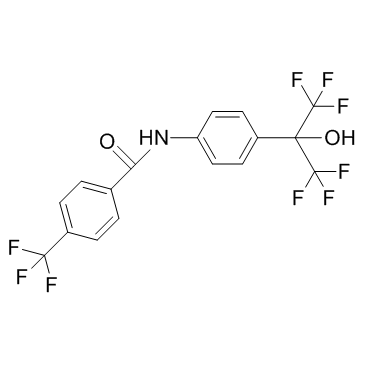
SR1078 structure
|
Common Name | SR1078 | ||
|---|---|---|---|---|
| CAS Number | 1246525-60-9 | Molecular Weight | 431.252 | |
| Density | 1.5±0.1 g/cm3 | Boiling Point | 362.9±42.0 °C at 760 mmHg | |
| Molecular Formula | C17H10F9NO2 | Melting Point | 169℃ | |
| MSDS | N/A | Flash Point | 173.3±27.9 °C | |
Use of SR1078SR1078 is an agonist of retinoic acid receptor-related orphan receptor α/γ (RORα/RORγ). |
This table lists Chinese names, IUPAC names and various aliases of this chemical substance.
| Name | N-[4-(1,1,1,3,3,3-hexafluoro-2-hydroxypropan-2-yl)phenyl]-4-(trifluoromethyl)benzamide |
|---|---|
| Synonym | More Synonyms |
This table contains bioactivity, target information and biological‑assay experimental data of this compound.
| Description | SR1078 is an agonist of retinoic acid receptor-related orphan receptor α/γ (RORα/RORγ). |
|---|---|
| Related Catalog | |
| Target |
RORα/γ[1] |
| In Vitro | SR1078 is a synthetic RORα/RORγ ligand. SR1078 modulates the conformation of RORγ in a biochemical assay and activates RORα and RORγ driven transcription. Furthermore, SR1078 stimulates expression of endogenous ROR target genes in HepG2 cells that express both RORα and RORγ. In a cell-based chimeric receptor Gal4 DNA-binding domain-NR ligand binding domain cotransfection assay, SR1078 significantly inhibits the constitutive transactivation activity of RORα and RORγ, but has no effect on the activity of FXR, LXRα and LXRβ. In a RORα cotransfection assay, treatment of cells with SR1078 (10 μM) results in a significant increase in transcription. Similarly, in the RORγ cotransfection assay, SR1078 treatment results in a stimulation of RORγ-dependent transcription activity[1]. |
| In Vivo | The pharmacokinetic properties of SR1078 are examined in mice and noted significant exposure. Plasma concentrations reach 3.6 μM 1h after a 10 mg/kg i.p. injection of SR1078 and sustained levels of above 800 nM even 8h after the single injection. These levels are sufficient to perform a proof-of-principle experiment to determine if SR1078 treatment would stimulate ROR target gene expression in an animal model. Mice are treated with SR1078 (10 mg/kg i.p.) and 2h after the injection the livers are harvested and mRNA purified for assessment of G6Pase and FGF21 gene expression.T he expression of both FGF21 and G6Pase is significantly stimulated by SR1078 treatment vs. vehicle control[1]. |
| Kinase Assay | The ALPHA screen assays are performed. Assays are performed in triplicate in white opaque 384-well plates under green light conditions (<100 lux) at room temperature. The final assay volume is 20 μL. All dilutions are made in assay buffer (100 mM NaCl, 25 mM Hepes, 0.1% (w/v) BSA, pH 7.4). The final DMSO concentration is 0.25% (v/v). A mix of 12 μL of GST-RORγ-LBD (10 nM), beads (12.5 μg/mL of each donor and acceptor), and 4 μL of increasing concentrations (210 nM-50 μM) of compound SR1078 are added to the wells, the plates are sealed and incubated for 1h. After this preincubation step, 4 μL of Biotin-TRAP220-2 peptide (50 nM) is added, the plates are sealed and further incubated for 2h. The plates are read on PerkinElmer Envision 2104 and data analyzed using GraphPad Prism software[1]. |
| Cell Assay | HEK293 cells are maintained in Dulbecco's modified Eagle's medium (DMEM) supplemented with 10% (v/v) fetal bovine serum at 37°C under 5% CO2. HepG2 cells are maintained and routinely propagated in minimum essential medium supplemented with 10% (v/v) fetal bovine serum at 37°C under 5% CO2. In experiments where lipids and sterols are depleted, cells are maintained on charcoal treated serum (10% (v/v) fetal bovine serum) and treated with 7.5 μM lovastatin and 100 μM mevalonic acid. 24 h prior to transfection, HepG2 or HEK293 cells are plated in 96-well plates at a density of 15×103 cells/well. Transfections are performed using LipofectamineTM 2000. 16 h post-transfection, the cells are treated with vehicle or SR1078. 24 h post-treatment, the luciferase activity is measured using the Dual-GloTM luciferase assay system. The experiments are repeated at least three times[1]. |
| Animal Admin | Mice[1] Plasma levels of SR1078 are evaluated in C57BL6 mice (n=3 per time point) administered by i.p. injection. After 1, 2, 4, and 8h blood is taken. In the 2h time point liver is taken for target gene analysis. Plasma is generated using standard centrifugation techniques, and the plasma and tissues are frozen at −80°C. Plasma and tissues are mixed with acetonitrile (1:5 (v/v) or 1:5 (w/v), respectively), sonicated with a probe tip sonicator, and analyzed for drug levels by liquid chromatography/tandem mass spectrometry. |
| References |
This table shows physicochemical parameters including melting point, boiling point, density, solubility and optical rotation. Missing data is marked as N/A.
| Density | 1.5±0.1 g/cm3 |
|---|---|
| Boiling Point | 362.9±42.0 °C at 760 mmHg |
| Melting Point | 169℃ |
| Molecular Formula | C17H10F9NO2 |
| Molecular Weight | 431.252 |
| Flash Point | 173.3±27.9 °C |
| Exact Mass | 431.056793 |
| PSA | 52.82000 |
| LogP | 5.27 |
| Vapour Pressure | 0.0±0.9 mmHg at 25°C |
| Index of Refraction | 1.493 |
| InChIKey | DUXWIYXHHGNUJU-UHFFFAOYSA-N |
| SMILES | O=C(Nc1ccc(C(O)(C(F)(F)F)C(F)(F)F)cc1)c1ccc(C(F)(F)F)cc1 |
| Storage condition | -20°C |
This table presents publicly reported synthetic routes, reaction conditions, reactants and product information of the compound.
|
~72%
SR1078 CAS#:1246525-60-9 |
| Literature: GRIFFIN, Patrick R.; ROUSH, William R.; KUMAR, Naresh; NUHANT, Philippe; BURRIS, Thomas; SOLT, Laura Patent: WO2011/115892 A1, 2011 ; Location in patent: Page/Page column 5; 87; 88 ; WO 2011/115892 A1 |

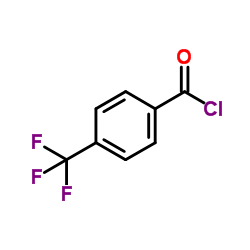
This table lists upstream starting materials and downstream derivative products related to this chemical.
| Precursor 2 | |
|---|---|
| DownStream 0 | |
This table contains target information, in‑vitro & in‑vivo assay data for this compound.
This table collects all English aliases, systematic names and CAS‑related synonyms of the compound.
| N-[4-(1,1,1,3,3,3-Hexafluoro-2-hydroxy-2-propanyl)phenyl]-4-(trifluoromethyl)benzamide |
| sr1078 |
| sr1078||sr-1078 |
| cs-1045 |
This section contains frequently‑asked‑questions about this compound, including basic parameters, properties, storage conditions and corresponding answers.
| Q: What are the storage conditions for N-[4-(1,1,1,3,3,3-hexafluoro-2-hydroxypropan-2-yl)phenyl]-4-(trifluoromethyl)benzamide? |
| A: Storage conditions for N-[4-(1,1,1,3,3,3-hexafluoro-2-hydroxypropan-2-yl)phenyl]-4-(trifluoromethyl)benzamide: -20°C. |
| Q: What English synonyms does N-[4-(1,1,1,3,3,3-hexafluoro-2-hydroxypropan-2-yl)phenyl]-4-(trifluoromethyl)benzamide have? |
| A: English synonyms of N-[4-(1,1,1,3,3,3-hexafluoro-2-hydroxypropan-2-yl)phenyl]-4-(trifluoromethyl)benzamide: N-[4-(1,1,1,3,3,3-Hexafluoro-2-hydroxy-2-propanyl)phenyl]-4-(trifluoromethyl)benzamide, sr1078, sr1078||sr-1078, cs-1045. |
| Q: What is the molecular formula of N-[4-(1,1,1,3,3,3-hexafluoro-2-hydroxypropan-2-yl)phenyl]-4-(trifluoromethyl)benzamide? |
| A: Molecular formula of N-[4-(1,1,1,3,3,3-hexafluoro-2-hydroxypropan-2-yl)phenyl]-4-(trifluoromethyl)benzamide is C17H10F9NO2. |
| Q: What is the molecular weight of N-[4-(1,1,1,3,3,3-hexafluoro-2-hydroxypropan-2-yl)phenyl]-4-(trifluoromethyl)benzamide? |
| A: Molecular weight of N-[4-(1,1,1,3,3,3-hexafluoro-2-hydroxypropan-2-yl)phenyl]-4-(trifluoromethyl)benzamide is 431.252. |
| Q: What are the uses of N-[4-(1,1,1,3,3,3-hexafluoro-2-hydroxypropan-2-yl)phenyl]-4-(trifluoromethyl)benzamide? |
| A: Main uses of N-[4-(1,1,1,3,3,3-hexafluoro-2-hydroxypropan-2-yl)phenyl]-4-(trifluoromethyl)benzamide: SR1078 is an agonist of retinoic acid receptor-related orphan receptor α/γ (RORα/RORγ). |
| Q: What is the polar surface area (PSA) of N-[4-(1,1,1,3,3,3-hexafluoro-2-hydroxypropan-2-yl)phenyl]-4-(trifluoromethyl)benzamide? |
| A: Polar surface area (PSA) of N-[4-(1,1,1,3,3,3-hexafluoro-2-hydroxypropan-2-yl)phenyl]-4-(trifluoromethyl)benzamide is 52.82000. |
| Q: What is the LogP of N-[4-(1,1,1,3,3,3-hexafluoro-2-hydroxypropan-2-yl)phenyl]-4-(trifluoromethyl)benzamide? |
| A: LogP of N-[4-(1,1,1,3,3,3-hexafluoro-2-hydroxypropan-2-yl)phenyl]-4-(trifluoromethyl)benzamide is 5.27. |
| Q: What is the boiling point of N-[4-(1,1,1,3,3,3-hexafluoro-2-hydroxypropan-2-yl)phenyl]-4-(trifluoromethyl)benzamide? |
| A: Boiling point of N-[4-(1,1,1,3,3,3-hexafluoro-2-hydroxypropan-2-yl)phenyl]-4-(trifluoromethyl)benzamide is 362.9±42.0 °C at 760 mmHg. |
| Q: What are the upstream materials of N-[4-(1,1,1,3,3,3-hexafluoro-2-hydroxypropan-2-yl)phenyl]-4-(trifluoromethyl)benzamide? |
| A: Related upstream materials(CAS) of N-[4-(1,1,1,3,3,3-hexafluoro-2-hydroxypropan-2-yl)phenyl]-4-(trifluoromethyl)benzamide: 722-92-9;329-15-7. |
| Q: What is the CAS number of N-[4-(1,1,1,3,3,3-hexafluoro-2-hydroxypropan-2-yl)phenyl]-4-(trifluoromethyl)benzamide? |
| A: CAS number of N-[4-(1,1,1,3,3,3-hexafluoro-2-hydroxypropan-2-yl)phenyl]-4-(trifluoromethyl)benzamide is 1246525-60-9. |
This table lists manufacturers and suppliers of this compound, including vendor names and product supply reference information.
| Shanghai Nianxing Industrial Co., Ltd |