Alectinib (CH5424802)

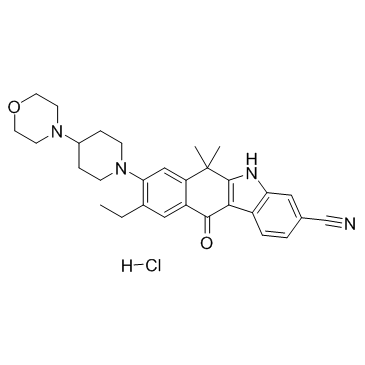
Alectinib (CH5424802) structure
|
Common Name | Alectinib (CH5424802) | ||
|---|---|---|---|---|
| CAS Number | 1256580-46-7 | Molecular Weight | 482.617 | |
| Density | 1.3±0.1 g/cm3 | Boiling Point | 722.5±60.0 °C at 760 mmHg | |
| Molecular Formula | C30H34N4O2 | Melting Point | N/A | |
| MSDS | N/A | Flash Point | 390.7±32.9 °C | |
Use of Alectinib (CH5424802)Alectinib (CH5424802) is a potent, selective, and orally available ALK inhibitor with an IC50 of 1.9 nM. |
Summary: 9-ethyl-6,6-dimethyl-8-(4-morpholin-4-ylpiperidin-1-yl)-11-oxo-5H-benzo[b]carbazole-3-carbonitrile (Alectinib), CAS number 1256580-46-7, molecular formula C30H34N4O2, molecular weight 482.617. For research-use only, not for medical or clinical usage.
This table lists Chinese names, IUPAC names and various aliases of this chemical substance.
| Name | 9-ethyl-6,6-dimethyl-8-(4-morpholin-4-ylpiperidin-1-yl)-11-oxo-5H-benzo[b]carbazole-3-carbonitrile |
|---|---|
| Synonym | More Synonyms |
This table contains bioactivity, target information and biological‑assay experimental data of this compound.
| Description | Alectinib (CH5424802) is a potent, selective, and orally available ALK inhibitor with an IC50 of 1.9 nM. |
|---|---|
| Related Catalog | |
| Target |
IC50: 1.9 nM(ALK), 1 nM (ALKF1174L), 3.5 nM (ALKR1275Q)[1] Kd: 2.4 nM (ALK)[1] |
| In Vitro | Alectinib (CH5424802) prevents autophosphorylation of ALK in NCI-H2228 NSCLC cells expressing EML4-ALK, and Alectinib also results in substantial suppression of phosphorylation of STAT3 and AKT, but not of ERK1/2[1]. Alectinib (CH5424802) shows high kinase selectivity and strong anti-proliferative activity against KARPAS-299 with an IC50 value of 3 nM[2]. |
| In Vivo | In the NCI-H2228 model, once-daily oral administration of Alectinib (CH5424802) results in dose-dependent tumor growth inhibition (ED50=0.46 mg/kg) and tumor regression. Treatment of 20 mg/kg Alectinib shows rapid tumor regression (168% tumor growth inhibition; p<0.001), the tumor volume in any mouse is <30 mm3 after 11 days of treatment (at day 28), a potent antitumor effect is maintained, and tumor re-growth dpes not occur throughout the 4-week drug-free period[1]. Oral administration of Alectinib (CH5424802) at 20 mg/kg displays significant tumor regression without body weight loss in an established ALK fusion gene-positive NSCLC xenograft model in mice[2]. Alectinib (Alectinib) at 60 mg/kg causes tumor regression against EML4-ALK-positive NCI-H2228 xenograft model and decreases the levels of phosphorylated ALK in this model. In addition, in mice at dose levels up to 60 mg/kg of CH5424802, there is no body weight loss, no significant change in peripheral blood cell count, no elevations of aspartate aminotransferase or alanine aminotransferase, and no substantial change in electrolytes. Oral administration of CH5424802 at 60 mg/kg for 4 days results in significant tumor regression seen in the luminescence signal[3]. |
| Kinase Assay | The inhibitory ability against each kinase except for MEK1 and Raf-1 is evaluated by examining their ability to phosphorylate various substrate peptides in the presence of Alectinib using time-resolved fluorescence resonance energy transfer (TR-FRET) assay or fluorescence polarization (FP) assay. The inhibitory activity against MEK1 is evaluated by quantitative analysis of the phosphorylation of a substrate peptide by a recombinant ERK2 protein in the presence of Alectinib. The inhibitory activity against Raf-1 is evaluated by examining the ability of the kinases to phosphorylate MEK1 in the presence of Alectinib[1]. |
| Cell Assay | Cells are cultured in 96-well plates overnight and incubated with various concentrations of Alectinib for the indicated time. For spheroid cell growth inhibition assay, cells are seeded on spheroid plates, incubated overnight, and then treated with Alectinib for the indicated times. The viable cells are measured by the CellTiter-Glo Luminescent Cell Viability Assay. Caspase-3/7 assay is evaluated using the Caspase-Glo 3/7 Assay Kit[1]. |
| Animal Admin | Mice[1] Cell lines are grown as s.c. tumors in SCID or nude mice. Therapeutic experiments are started (day 0) when the tumor reaches ~250 or ~350 mm3. Mice are randomized to treatment groups to receive vehicle or Alectinib (oral, qd) for the indicated duration. Final concentration of vehicle is 0.02 N HCl, 10% DMSO, 10% Cremophor EL, 15% PEG400, and 15% HPCD (2-hydroxypropyl-β-cyclodextrin). The length (L) and width (W) of the tumor mass are measured, and the tumor volume (TV) is calculated as: TV=(L×W2)/2. Tumor growth inhibition is calculated using the following formula: tumor growth inhibition=[1−(T−T0)/(C−C0)]×100. The ED50 is calculated from the values of tumor growth inhibition on the final experimental day. Rats[3] Plasma and brain (cerebrum and cerebellum) samples are prepared at various time points between 4 and 168 h after a single oral administration of 14C-labeled Alectinib (Alectinib) at 1 mg/kg to a rat. The radioactivity concentrations in plasma are determined by a liquid scintillation counter, and the radioactivity concentrations in brain are quantified using quantitative whole-body autography. |
| References |
This table shows physicochemical parameters including melting point, boiling point, density, solubility and optical rotation. Missing data is marked as N/A.
| Density | 1.3±0.1 g/cm3 |
|---|---|
| Boiling Point | 722.5±60.0 °C at 760 mmHg |
| Molecular Formula | C30H34N4O2 |
| Molecular Weight | 482.617 |
| Flash Point | 390.7±32.9 °C |
| Exact Mass | 482.268188 |
| PSA | 72.36000 |
| LogP | 5.48 |
| Vapour Pressure | 0.0±2.3 mmHg at 25°C |
| Index of Refraction | 1.673 |
| InChIKey | KDGFLJKFZUIJMX-UHFFFAOYSA-N |
| SMILES | CCc1cc2c(cc1N1CCC(N3CCOCC3)CC1)C(C)(C)c1[nH]c3cc(C#N)ccc3c1C2=O |
| Storage condition | -20°C |
This table presents publicly reported synthetic routes, reaction conditions, reactants and product information of the compound.
|
~25%
Alectinib (CH54... CAS#:1256580-46-7 |
| Literature: Bioorganic and Medicinal Chemistry, , vol. 20, # 3 p. 1271 - 1280 |
![9-ethynyl-6,6-diMethyl-8-(4-Morpholinopiperidin-1-yl)-11-oxo-6,11-dihydro-5H-benzo[b]carbazole-3-carbonitrile structure](https://image.chemsrc.com/caspic/320/1256580-24-1.png)
This table lists upstream starting materials and downstream derivative products related to this chemical.
| Precursor 0 | |
|---|---|
| DownStream 1 | |
 CAS#:1256589-74-8
This table contains target information, in‑vitro & in‑vivo assay data for this compound.
This table collects all English aliases, systematic names and CAS‑related synonyms of the compound.
| AF802 |
| Alectinib |
| UNII:LIJ4CT1Z3Y |
| 9-Ethyl-6,6-dimethyl-8-[4-(4-morpholinyl)-1-piperidinyl]-11-oxo-6,11-dihydro-5H-benzo[b]carbazole-3-carbonitrile |
| UNII-LIJ4CT1Z3Y |
| CH5424802 |
| 9-ethyl-6,6-dimethyl-8-(4-morpholin-4-ylpiperidin-1-yl)-11-oxo-6,11-dihydro-5H-benzo[b]carbazole-3-carbonitrile |
| 9-ethyl-6,11-dihydro-6,6-dimethyl-8-(4-(4-morpholinyl)-1-piperidinyl)-11-oxo-5h-benzo(b)carbazole-3-carbonitrile |
| 9-Ethyl-6,11-dihydro-6,6-dimethyl-8-[4-(4-morpholinyl)-1-piperidinyl]-11-oxo-5H-benzo[b]carbazole-3-carbonitrile |
This section contains frequently‑asked‑questions about this compound, including basic parameters, properties, storage conditions and corresponding answers.
| Q: What is the SMILES notation of 9-ethyl-6,6-dimethyl-8-(4-morpholin-4-ylpiperidin-1-yl)-11-oxo-5H-benzo[b]carbazole-3-carbonitrile? |
| A: SMILES notation of 9-ethyl-6,6-dimethyl-8-(4-morpholin-4-ylpiperidin-1-yl)-11-oxo-5H-benzo[b]carbazole-3-carbonitrile is CCc1cc2c(cc1N1CCC(N3CCOCC3)CC1)C(C)(C)c1[nH]c3cc(C#N)ccc3c1C2=O. |
| Q: What is the InChIKey of 9-ethyl-6,6-dimethyl-8-(4-morpholin-4-ylpiperidin-1-yl)-11-oxo-5H-benzo[b]carbazole-3-carbonitrile? |
| A: InChIKey of 9-ethyl-6,6-dimethyl-8-(4-morpholin-4-ylpiperidin-1-yl)-11-oxo-5H-benzo[b]carbazole-3-carbonitrile is KDGFLJKFZUIJMX-UHFFFAOYSA-N. |
| Q: What is the CAS number of 9-ethyl-6,6-dimethyl-8-(4-morpholin-4-ylpiperidin-1-yl)-11-oxo-5H-benzo[b]carbazole-3-carbonitrile? |
| A: CAS number of 9-ethyl-6,6-dimethyl-8-(4-morpholin-4-ylpiperidin-1-yl)-11-oxo-5H-benzo[b]carbazole-3-carbonitrile is 1256580-46-7. |
| Q: What are the downstream products of 9-ethyl-6,6-dimethyl-8-(4-morpholin-4-ylpiperidin-1-yl)-11-oxo-5H-benzo[b]carbazole-3-carbonitrile? |
| A: Related downstream products(CAS) of 9-ethyl-6,6-dimethyl-8-(4-morpholin-4-ylpiperidin-1-yl)-11-oxo-5H-benzo[b]carbazole-3-carbonitrile: 1256589-74-8. |
| Q: What are the storage conditions for 9-ethyl-6,6-dimethyl-8-(4-morpholin-4-ylpiperidin-1-yl)-11-oxo-5H-benzo[b]carbazole-3-carbonitrile? |
| A: Storage conditions for 9-ethyl-6,6-dimethyl-8-(4-morpholin-4-ylpiperidin-1-yl)-11-oxo-5H-benzo[b]carbazole-3-carbonitrile: -20°C. |
| Q: What is the LogP of 9-ethyl-6,6-dimethyl-8-(4-morpholin-4-ylpiperidin-1-yl)-11-oxo-5H-benzo[b]carbazole-3-carbonitrile? |
| A: LogP of 9-ethyl-6,6-dimethyl-8-(4-morpholin-4-ylpiperidin-1-yl)-11-oxo-5H-benzo[b]carbazole-3-carbonitrile is 5.48. |
| Q: What is the English name of 9-ethyl-6,6-dimethyl-8-(4-morpholin-4-ylpiperidin-1-yl)-11-oxo-5H-benzo[b]carbazole-3-carbonitrile? |
| A: The English name of 9-ethyl-6,6-dimethyl-8-(4-morpholin-4-ylpiperidin-1-yl)-11-oxo-5H-benzo[b]carbazole-3-carbonitrile is 9-ethyl-6,6-dimethyl-8-(4-morpholin-4-ylpiperidin-1-yl)-11-oxo-5H-benzo[b]carbazole-3-carbonitrile. |
| Q: What is the molecular weight of 9-ethyl-6,6-dimethyl-8-(4-morpholin-4-ylpiperidin-1-yl)-11-oxo-5H-benzo[b]carbazole-3-carbonitrile? |
| A: Molecular weight of 9-ethyl-6,6-dimethyl-8-(4-morpholin-4-ylpiperidin-1-yl)-11-oxo-5H-benzo[b]carbazole-3-carbonitrile is 482.617. |
| Q: What is the molecular formula of 9-ethyl-6,6-dimethyl-8-(4-morpholin-4-ylpiperidin-1-yl)-11-oxo-5H-benzo[b]carbazole-3-carbonitrile? |
| A: Molecular formula of 9-ethyl-6,6-dimethyl-8-(4-morpholin-4-ylpiperidin-1-yl)-11-oxo-5H-benzo[b]carbazole-3-carbonitrile is C30H34N4O2. |
| Q: What are the uses of 9-ethyl-6,6-dimethyl-8-(4-morpholin-4-ylpiperidin-1-yl)-11-oxo-5H-benzo[b]carbazole-3-carbonitrile? |
| A: Main uses of 9-ethyl-6,6-dimethyl-8-(4-morpholin-4-ylpiperidin-1-yl)-11-oxo-5H-benzo[b]carbazole-3-carbonitrile: Alectinib (CH5424802) is a potent, selective, and orally available ALK inhibitor with an IC50 of 1.9 nM. |
This table lists manufacturers and suppliers of this compound, including vendor names and product supply reference information.
| Shanghai Nianxing Industrial Co., Ltd |