Dihexa
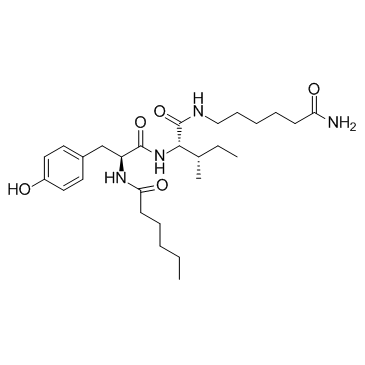
Dihexa structure
|
Common Name | Dihexa | ||
|---|---|---|---|---|
| CAS Number | 1401708-83-5 | Molecular Weight | 504.662 | |
| Density | 1.1±0.1 g/cm3 | Boiling Point | 866.2±65.0 °C at 760 mmHg | |
| Molecular Formula | C27H44N4O5 | Melting Point | N/A | |
| MSDS | N/A | Flash Point | 477.6±34.3 °C | |
Use of DihexaDihexa is an orally active, blood-brain barrier-permeable angiotensin IV analog; exhibits high affinity binding hepatocyte growth factor (HGF) with a Kd of 65 pM. |
This table lists Chinese names, IUPAC names and various aliases of this chemical substance.
| Name | Dihexa |
|---|---|
| Synonym | More Synonyms |
This table contains bioactivity, target information and biological‑assay experimental data of this compound.
| Description | Dihexa is an orally active, blood-brain barrier-permeable angiotensin IV analog; exhibits high affinity binding hepatocyte growth factor (HGF) with a Kd of 65 pM. |
|---|---|
| Related Catalog | |
| Target |
Kd: 65 pM (HGF)[1] |
| In Vitro | Dihexa binds with high affinity to HGF and both dihexa and its parent compound Norleucine 1-AngIV induce c-Met phosphorylation in the presence of subthreshold concentrations of HGF and augment HGF-dependent cell scattering. Further, dihexa and Nle1-AngIV induce hippocampal spinogenesis and synaptogenesis similar to HGF itself. Dihexa effectively inhibits HGF dimerization at 1 μM. While dihexa at 1 nM and 10 pM alone does not activate c-Met, it markedly augments the capacity of HGF at 1.25 and 2.5 ng/mL to activate c-Met[1]. |
| In Vivo | Dihexa has a long circulating half-life. Dihexa exhibits procognitive activity. Dihexa reverses scopolamine-dependent spatial learning deficits. It improves spatial learning in aged rats. Dihexa induces spinogenesis in cultured hippocampal neurons[2]. |
| Animal Admin | Rats: Serial dilutions of dihexa in 50% DMSO or water (for dilutions of 50 µg/mL or less) are prepared from the stock used to dose the animals to be used for preparation of a standard curve. 10 µL of each serial dilution is then added to 90 µL of blank plasma for final concentrations of 0.01, 0.02, 0.05, 0.1, 0.2, 1, 10, 20, 50, and 100 µg/mL. 80 µL of each plasma sample is transferred to previously prepared tubes containing 240 µL of ice-cold acetonitrile and vortexed vigorously. 10 µL of isotonic saline containing 100 µg/mL Nle-YI-(6) aminohexanoic amide as an internal standard is added to each sample on ice. The standard-curve plasma samples are then stored at −20°C and further processed alongside the pharmacokinetic study samples[2]. |
| References |
This table shows physicochemical parameters including melting point, boiling point, density, solubility and optical rotation. Missing data is marked as N/A.
| Density | 1.1±0.1 g/cm3 |
|---|---|
| Boiling Point | 866.2±65.0 °C at 760 mmHg |
| Molecular Formula | C27H44N4O5 |
| Molecular Weight | 504.662 |
| Flash Point | 477.6±34.3 °C |
| Exact Mass | 504.331177 |
| LogP | 2.78 |
| Vapour Pressure | 0.0±0.3 mmHg at 25°C |
| Index of Refraction | 1.529 |
| InChIKey | XEUVNVNAVKZSPT-JTJYXVOQSA-N |
| SMILES | CCCCCC(=O)NC(Cc1ccc(O)cc1)C(=O)NC(C(=O)NCCCCCC(N)=O)C(C)CC |
| Storage condition | 2-8℃ |
This table collects all English aliases, systematic names and CAS‑related synonyms of the compound.
| Dihexa |
| N-Hexanoyl-L-tyrosyl-N-(6-amino-6-oxohexyl)-L-isoleucinamide |
| PNB-0408 |
This section contains frequently‑asked‑questions about this compound, including basic parameters, properties, storage conditions and corresponding answers.
| Q: What are the storage conditions for Dihexa? |
| A: Storage conditions for Dihexa: 2-8℃. |
| Q: What is the CAS number of Dihexa? |
| A: CAS number of Dihexa is 1401708-83-5. |
| Q: What English synonyms does Dihexa have? |
| A: English synonyms of Dihexa: Dihexa, N-Hexanoyl-L-tyrosyl-N-(6-amino-6-oxohexyl)-L-isoleucinamide, PNB-0408. |
| Q: What is the English name of Dihexa? |
| A: The English name of Dihexa is Dihexa. |
| Q: What is the boiling point of Dihexa? |
| A: Boiling point of Dihexa is 866.2±65.0 °C at 760 mmHg. |
| Q: What is the molecular formula of Dihexa? |
| A: Molecular formula of Dihexa is C27H44N4O5. |
| Q: What is the LogP of Dihexa? |
| A: LogP of Dihexa is 2.78. |
| Q: What is the molecular weight of Dihexa? |
| A: Molecular weight of Dihexa is 504.662. |
| Q: What are the uses of Dihexa? |
| A: Main uses of Dihexa: Dihexa is an orally active, blood-brain barrier-permeable angiotensin IV analog; exhibits high affinity binding hepatocyte growth factor (HGF) with a Kd of 65 pM. |
| Q: What is the InChIKey of Dihexa? |
| A: InChIKey of Dihexa is XEUVNVNAVKZSPT-JTJYXVOQSA-N. |
This table lists manufacturers and suppliers of this compound, including vendor names and product supply reference information.
| Shanghai Nianxing Industrial Co., Ltd |
| Henan Tianfu Chemical Co., Ltd. |