Conivaptan HCl
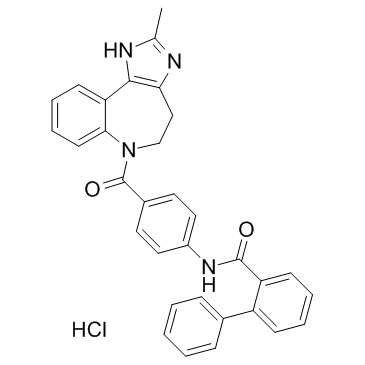
Conivaptan HCl structure
|
Common Name | Conivaptan HCl | ||
|---|---|---|---|---|
| CAS Number | 168626-94-6 | Molecular Weight | 535.035 | |
| Density | N/A | Boiling Point | 751.2ºC at 760 mmHg | |
| Molecular Formula | C32H27ClN4O2 | Melting Point | >250° | |
| MSDS | N/A | Flash Point | 408.1ºC | |
Use of Conivaptan HClConivaptan (hydrochloride) is a non-peptide antagonist of vasopressin receptor, with Ki values of 0.48 and 3.04 nM for rat liver V1A receptor and rat kidney V2 receptor respectively. |
This table lists Chinese names, IUPAC names and various aliases of this chemical substance.
| Name | conivaptan hydrochloride |
|---|---|
| Synonym | More Synonyms |
This table contains bioactivity, target information and biological‑assay experimental data of this compound.
| Description | Conivaptan (hydrochloride) is a non-peptide antagonist of vasopressin receptor, with Ki values of 0.48 and 3.04 nM for rat liver V1A receptor and rat kidney V2 receptor respectively. |
|---|---|
| Related Catalog | |
| Target |
Ki: 0.48 nM (V1A receptor), 3.04 nM (V2 receptor) |
| In Vivo | Conivaptan (0.03, 0.1 and 0.3 mg/kg, i.v.) dose-dependently increases urine volume and reduces urine osmolality in both myocardial infarction and sham-operated rats. Conivaptan (0.3 mg/kg i.v.) significantly reduces right ventricular systolic pressure, left ventricular end-diastolic pressure, lung/body weight and right atrial pressure in myocardial infarction rats. Conivaptan (0.3 mg/kg i.v.) significantly increases dP/dt(max)/left ventricular pressure in myocardial infarction rats[1]. Conivaptan produces an acute increase in urine volume (UV), a reduction in osmolality (UOsm) and, at the end of the investigation, cirrhotic rats receiving the V(1a)/V(2)-AVP receptor antagonist does not show hyponatremia or hypoosmolality. Conivaptan also normalizes U(Na)V without affecting creatinine clearance and arterial pressure[2]. Conivaptan (0.01 to 0.1 mg/kg, i.v.) exerts a dose-dependent diuretic effect in dogs without an increase in the urinary excretion of electrolytes, inhibits the pressor effect of exogenous vasopressin in a dose-dependent manner (0.003 to 0.1 mg/kg i.v.) and, at the highest dose (0.1 mg/kg i.v.), almost completely blocks vasoconstriction caused by exogenous vasopressin. Conivaptan (0.1 mg/kg, i.v.) improves cardiac function, as evidenced by significant increases in left ventricular dP/dtmax, cardiac output and stroke volume, and reduces preload and afterload, as evidenced by significant decreases in left ventricular end-diastolic pressure and total peripheral vascular resistance in dogs with congestive heart failure[3]. |
| Animal Admin | At 4 weeks after the operation, 39 myocardial infarction rats survived. Thirty are randomly selected without bias and divided into five groups such that the distribution of infarct size and body weight among groups are similar, and given vehicle, conivaptan (0.03, 0.1 and 0.3 mg/kg) or SR121463A (0.3 mg/kg) by intravenous administration. Sham rats are also divided into four groups and given vehicle or conivaptan (0.03, 0.1 and 0.3 mg/kg) by intravenous administration. Rats are then placed individually in metabolic cages and urine is collected for 3 h. Urine osmolality is measured by the freezing point depression method using an osmometer. |
| References |
This table shows physicochemical parameters including melting point, boiling point, density, solubility and optical rotation. Missing data is marked as N/A.
| Boiling Point | 751.2ºC at 760 mmHg |
|---|---|
| Melting Point | >250° |
| Molecular Formula | C32H27ClN4O2 |
| Molecular Weight | 535.035 |
| Flash Point | 408.1ºC |
| Exact Mass | 534.182251 |
| PSA | 78.09000 |
| LogP | 7.44730 |
| Vapour Pressure | 1.89E-22mmHg at 25°C |
| InChIKey | BTYHAFSDANBVMJ-UHFFFAOYSA-N |
| SMILES | Cc1nc2c([nH]1)CCN(C(=O)c1ccc(NC(=O)c3ccccc3-c3ccccc3)cc1)c1ccccc1-2.Cl |
| Storage condition | -20°C |
This table covers safety warnings, protective measures, incompatible substances and disposal guidelines for this compound.
| Hazard Codes | Xi |
|---|
This table collects all English aliases, systematic names and CAS‑related synonyms of the compound.
| (1,1'-Biphenyl)-2-carboxamide,N-(4-((4,5-dihydro-2-methylimidazo(4,5-d)(1)benzazepin-6(1H)-yl)carbonyl)phenyl)-,monohydrochloride |
| Conivaptan hydrochloride |
| N-{4-[(2-methyl-4,5-dihydroimidazo[4,5-d][1]benzazepin-6(1H)-yl)carbonyl]phenyl}biphenyl-2-carboxamide hydrochloride |
| YM-087 |
| UNII-75L57R6X36 |
| N-[4-(2-methyl-4,5-dihydro-3H-imidazo[4,5-d][1]benzazepine-6-carbonyl)phenyl]-2-phenylbenzamide,hydrochloride |
| [1,1'-Biphenyl]-2-carboxamide, N-[4-[(4,5-dihydro-2-methylimidazo[4,5-d][1]benzazepin-6(1H)-yl)carbonyl]phenyl]-, hydrochloride (1:1) |
| N-{4-[(2-Methyl-4,5-dihydroimidazo[4,5-d][1]benzazepin-6(1H)-yl)carbonyl]phenyl}-2-biphenylcarboxamide hydrochloride (1:1) |
| Vaprisol |
| CI-1025 |
| Conivaptanhydrochloride |
| [1,1'-biphenyl]-2-carboxamide, N-[4-[(4,5-dihydro-2-methylimidazo[4,5-d][1]benzazepin-6(1H)-yl)carbonyl]phenyl]-, monohydrochloride |
| Conivaptan HCl |
| Conivaptan hydrochloride [USAN] |
| Conivaptan HCI |
| Conivaptan (hydrochloride) |
This section contains frequently‑asked‑questions about this compound, including basic parameters, properties, storage conditions and corresponding answers.
| Q: What is the LogP of conivaptan hydrochloride? |
| A: LogP of conivaptan hydrochloride is 7.44730. |
| Q: What is the SMILES notation of conivaptan hydrochloride? |
| A: SMILES notation of conivaptan hydrochloride is Cc1nc2c([nH]1)CCN(C(=O)c1ccc(NC(=O)c3ccccc3-c3ccccc3)cc1)c1ccccc1-2.Cl. |
| Q: What are the storage conditions for conivaptan hydrochloride? |
| A: Storage conditions for conivaptan hydrochloride: -20°C. |
| Q: What is the English name of conivaptan hydrochloride? |
| A: The English name of conivaptan hydrochloride is conivaptan hydrochloride. |
| Q: What is the boiling point of conivaptan hydrochloride? |
| A: Boiling point of conivaptan hydrochloride is 751.2ºC at 760 mmHg. |
| Q: What is the CAS number of conivaptan hydrochloride? |
| A: CAS number of conivaptan hydrochloride is 168626-94-6. |
| Q: What are the uses of conivaptan hydrochloride? |
| A: Main uses of conivaptan hydrochloride: Conivaptan (hydrochloride) is a non-peptide antagonist of vasopressin receptor, with Ki values of 0.48 and 3.04 nM for rat liver V1A receptor and rat kidney V2 receptor respectively. |
| Q: What is the InChIKey of conivaptan hydrochloride? |
| A: InChIKey of conivaptan hydrochloride is BTYHAFSDANBVMJ-UHFFFAOYSA-N. |
| Q: What is the polar surface area (PSA) of conivaptan hydrochloride? |
| A: Polar surface area (PSA) of conivaptan hydrochloride is 78.09000. |
| Q: What is the molecular weight of conivaptan hydrochloride? |
| A: Molecular weight of conivaptan hydrochloride is 535.035. |
This table lists manufacturers and suppliers of this compound, including vendor names and product supply reference information.
| Shanghai Nianxing Industrial Co., Ltd |
| Dayang Chem (Hangzhou) Co., Ltd. |
| Henan Tianfu Chemical Co., Ltd. |