Alexidine dihydrochloride
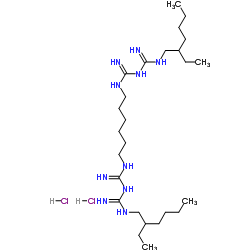
Alexidine dihydrochloride structure
|
Common Name | Alexidine dihydrochloride | ||
|---|---|---|---|---|
| CAS Number | 1715-30-6 | Molecular Weight | 581.712 | |
| Density | 1.1g/cm3 | Boiling Point | 658.2ºC at 760mmHg | |
| Molecular Formula | C26H58Cl2N10 | Melting Point | 220.6-223.4ºC | |
| MSDS | Chinese USA | Flash Point | 351.8ºC | |
| Symbol |

GHS07 |
Signal Word | Warning | |
Use of Alexidine dihydrochlorideAlexidine dihydrochloride is an anticancer agent that targets a mitochondrial tyrosine phosphatase, PTPMT1, in mammalian cells and causes mitochondrial apoptosis. Alexidine dihydrochloride has antifungal and antibiofilm activity against a diverse range of fungal pathogens[1]. |
This table lists Chinese names, IUPAC names and various aliases of this chemical substance.
| Name | Alexidine dihydrochloride,N,N''-Bis(2-ethylhexyl)-3,12-diimino-2,4,11,13-tetraazatetradecanediimidamidedihydrochloride |
|---|---|
| Synonym | More Synonyms |
This table contains bioactivity, target information and biological‑assay experimental data of this compound.
| Description | Alexidine dihydrochloride is an anticancer agent that targets a mitochondrial tyrosine phosphatase, PTPMT1, in mammalian cells and causes mitochondrial apoptosis. Alexidine dihydrochloride has antifungal and antibiofilm activity against a diverse range of fungal pathogens[1]. |
|---|---|
| Related Catalog | |
| Target |
PTPMT1[1] |
| In Vitro | Alexidine dihydrochloride displays activity against most Candida spp.; MIC values of ≤1.5 μg/mL are observed for all isolates tested under planktonic conditions, with the exception of Candida parapsilosis and Candida krusei. Interestingly, Alexidine dihydrochloride also displays striking activity against clinically relevant fluconazole-resistant Candida isolates: C. albicans (CA2, CA6, and CA10), C. glabrata (CG2 and CG5), C. parapsilosis (CP5), and C. auris (CAU-09 and CAU-03)[1]. Inhibition of planktonic growth by Alexidine dihydrochloride reveals a complete inhibition of filamentation or proliferation of the imaged fungi. Alexidine dihydrochloride is able to decimate at low concentrations (1.5 to 6 μg/mL) mature biofilms of Candida, Cryptococcus, and Aspergillus spp. that are known to be resistant to almost all classes of antifungal drugs. In fact, at 10-fold-lower concentrations (150 ng/mL) of planktonic MICs, Alexidine dihydrochloride could inhibit lateral yeast formation and biofilm dispersal in C. albicans[1]. Alexidine dihydrochloride results in 50% killing of HUVECs and lung epithelial cells, at concentrations 5- to 10-fold higher than the MIC required to kill planktonically growing fungal pathogens[1]. |
| In Vivo | Chosen to focus on biofilm formation by C. albicans, since a murine biofilm model has been well established in this fungus and used for testing the effects of established and new antifungal agents. The effect of the drugs on the 24-h-old biofilms growing in the jugular vein catheters of mice is visualized microscopically, which reveals significantly lower density of the biofilms in catheters treated with Alexidine dihydrochloride. In fact, fungal CFU determination reveals that Alexidine dihydrochloride inhibits 67% of fungal biofilm growth and viability, compared to the control untreated biofilms[1]. |
| References |
This table shows physicochemical parameters including melting point, boiling point, density, solubility and optical rotation. Missing data is marked as N/A.
| Density | 1.1g/cm3 |
|---|---|
| Boiling Point | 658.2ºC at 760mmHg |
| Melting Point | 220.6-223.4ºC |
| Molecular Formula | C26H58Cl2N10 |
| Molecular Weight | 581.712 |
| Flash Point | 351.8ºC |
| Exact Mass | 580.422302 |
| PSA | 167.58000 |
| LogP | 8.60460 |
| Vapour Pressure | 3.38E-17mmHg at 25°C |
| InChIKey | BRJJFBHTDVWTCJ-UHFFFAOYSA-N |
| SMILES | CCCCC(CC)CN=C(N)NC(N)=NCCCCCCN=C(N)NC(N)=NCC(CC)CCCC.Cl.Cl |
This table covers safety warnings, protective measures, incompatible substances and disposal guidelines for this compound.
| Symbol |
GHS07 |
|---|---|
| Signal Word | Warning |
| Hazard Statements | H315-H319-H335 |
| Precautionary Statements | P261-P305 + P351 + P338 |
| RIDADR | NONH for all modes of transport |
This table lists relevant public references with title, journal and publication metadata for this compound.
|
Chemical interaction of alexidine and sodium hypochlorite.
J. Endod. 38(1) , 112-6, (2012) Recent studies have reported the color change and formation of precipitates containing para-chloroaniline (PCA) after a reaction of sodium hypochlorite (NaOCl) and chlorhexidine (CHX). Alexidine (ALX)... |
|
|
Quantitative high throughput screening using a primary human three-dimensional organotypic culture predicts in vivo efficacy.
Nat. Commun. 6 , 6220, (2015) The tumour microenvironment contributes to cancer metastasis and drug resistance. However, most high throughput screening (HTS) assays for drug discovery use cancer cells grown in monolayers. Here we ... |
|
|
Pan-antimicrobial failure of alexidine as a contact lens disinfectant when heated in Bausch & Lomb plastic containers: implications for the worldwide Fusarium keratitis epidemic of 2004 to 2006.
Eye Contact Lens 38(4) , 222-6, (2012) ReNu with MoistureLoc (ReNuML), containing the antimicrobial agent alexidine 0.00045%, was associated with the Fusarium keratitis epidemic of 2004 to 2006. Although a single-point source contamination... |
This table contains target information, in‑vitro & in‑vivo assay data for this compound.
This table collects all English aliases, systematic names and CAS‑related synonyms of the compound.
| N,N''''-1,6-Hexanediylbis[N'-(2-ethylhexyl)(imidodicarbonimidic diamide)] dihydrochloride |
| n,n''''-hexane-1,6-diylbis[n'-(2-ethylhexyl)(imidodicarbonimidic diamide)] dihydrochloride |
| Alexidine dihydrochloride |
| Imidodicarbonimidic diamide, N,N''''-1,6-hexanediylbis[N'-(2-ethylhexyl)-, hydrochloride (1:2) |
| Bisguadine |
| Sterwin 904 |
| UNII:I2A7616PY1 |
| alexidine 2HCl |
| 1,1'-Hexamethylene-bis(5-[2-ethylhexyl]biguanide) |
| QR-711 |
| Bisguanidine |
| Compound-904 |
This section contains frequently‑asked‑questions about this compound, including basic parameters, properties, storage conditions and corresponding answers.
| Q: What are the uses of Alexidine dihydrochloride,N,N''-Bis(2-ethylhexyl)-3,12-diimino-2,4,11,13-tetraazatetradecanediimidamidedihydrochloride? |
| A: Main uses of Alexidine dihydrochloride,N,N''-Bis(2-ethylhexyl)-3,12-diimino-2,4,11,13-tetraazatetradecanediimidamidedihydrochloride: Alexidine dihydrochloride is an anticancer agent that targets a mitochondrial tyrosine phosphatase, PTPMT1, in mammalian cells and causes mitochondrial apoptosis. Alexidine dihydrochloride has antifungal and antibiofilm activity against a diverse range of fungal pathogens[1]. |
| Q: What is the SMILES notation of Alexidine dihydrochloride,N,N''-Bis(2-ethylhexyl)-3,12-diimino-2,4,11,13-tetraazatetradecanediimidamidedihydrochloride? |
| A: SMILES notation of Alexidine dihydrochloride,N,N''-Bis(2-ethylhexyl)-3,12-diimino-2,4,11,13-tetraazatetradecanediimidamidedihydrochloride is CCCCC(CC)CN=C(N)NC(N)=NCCCCCCN=C(N)NC(N)=NCC(CC)CCCC.Cl.Cl. |
| Q: What is the InChIKey of Alexidine dihydrochloride,N,N''-Bis(2-ethylhexyl)-3,12-diimino-2,4,11,13-tetraazatetradecanediimidamidedihydrochloride? |
| A: InChIKey of Alexidine dihydrochloride,N,N''-Bis(2-ethylhexyl)-3,12-diimino-2,4,11,13-tetraazatetradecanediimidamidedihydrochloride is BRJJFBHTDVWTCJ-UHFFFAOYSA-N. |
| Q: What is the polar surface area (PSA) of Alexidine dihydrochloride,N,N''-Bis(2-ethylhexyl)-3,12-diimino-2,4,11,13-tetraazatetradecanediimidamidedihydrochloride? |
| A: Polar surface area (PSA) of Alexidine dihydrochloride,N,N''-Bis(2-ethylhexyl)-3,12-diimino-2,4,11,13-tetraazatetradecanediimidamidedihydrochloride is 167.58000. |
| Q: What is the CAS number of Alexidine dihydrochloride,N,N''-Bis(2-ethylhexyl)-3,12-diimino-2,4,11,13-tetraazatetradecanediimidamidedihydrochloride? |
| A: CAS number of Alexidine dihydrochloride,N,N''-Bis(2-ethylhexyl)-3,12-diimino-2,4,11,13-tetraazatetradecanediimidamidedihydrochloride is 1715-30-6. |
| Q: What is the melting point of Alexidine dihydrochloride,N,N''-Bis(2-ethylhexyl)-3,12-diimino-2,4,11,13-tetraazatetradecanediimidamidedihydrochloride? |
| A: Melting point of Alexidine dihydrochloride,N,N''-Bis(2-ethylhexyl)-3,12-diimino-2,4,11,13-tetraazatetradecanediimidamidedihydrochloride is 220.6-223.4ºC. |
| Q: What is the molecular weight of Alexidine dihydrochloride,N,N''-Bis(2-ethylhexyl)-3,12-diimino-2,4,11,13-tetraazatetradecanediimidamidedihydrochloride? |
| A: Molecular weight of Alexidine dihydrochloride,N,N''-Bis(2-ethylhexyl)-3,12-diimino-2,4,11,13-tetraazatetradecanediimidamidedihydrochloride is 581.712. |
| Q: What is the boiling point of Alexidine dihydrochloride,N,N''-Bis(2-ethylhexyl)-3,12-diimino-2,4,11,13-tetraazatetradecanediimidamidedihydrochloride? |
| A: Boiling point of Alexidine dihydrochloride,N,N''-Bis(2-ethylhexyl)-3,12-diimino-2,4,11,13-tetraazatetradecanediimidamidedihydrochloride is 658.2ºC at 760mmHg. |
| Q: What is the LogP of Alexidine dihydrochloride,N,N''-Bis(2-ethylhexyl)-3,12-diimino-2,4,11,13-tetraazatetradecanediimidamidedihydrochloride? |
| A: LogP of Alexidine dihydrochloride,N,N''-Bis(2-ethylhexyl)-3,12-diimino-2,4,11,13-tetraazatetradecanediimidamidedihydrochloride is 8.60460. |
| Q: What is the English name of Alexidine dihydrochloride,N,N''-Bis(2-ethylhexyl)-3,12-diimino-2,4,11,13-tetraazatetradecanediimidamidedihydrochloride? |
| A: The English name of Alexidine dihydrochloride,N,N''-Bis(2-ethylhexyl)-3,12-diimino-2,4,11,13-tetraazatetradecanediimidamidedihydrochloride is Alexidine dihydrochloride,N,N''-Bis(2-ethylhexyl)-3,12-diimino-2,4,11,13-tetraazatetradecanediimidamidedihydrochloride. |
This table lists manufacturers and suppliers of this compound, including vendor names and product supply reference information.
| Shanghai Nianxing Industrial Co., Ltd |
| Dayang Chem (Hangzhou) Co., Ltd. |