SB 225002
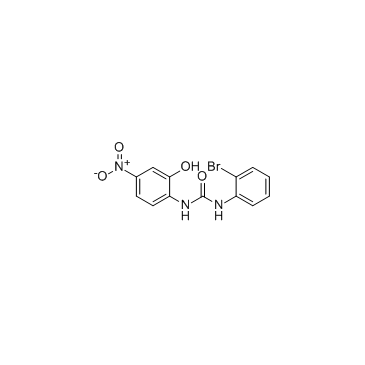
SB 225002 structure
|
Common Name | SB 225002 | ||
|---|---|---|---|---|
| CAS Number | 182498-32-4 | Molecular Weight | 352.140 | |
| Density | 1.8±0.1 g/cm3 | Boiling Point | 401.6±45.0 °C at 760 mmHg | |
| Molecular Formula | C13H10BrN3O4 | Melting Point | N/A | |
| MSDS | Chinese USA | Flash Point | 196.7±28.7 °C | |
| Symbol |

GHS07 |
Signal Word | Warning | |
Use of SB 225002SB225002 is a potent and selective CXCR2 antagonist with an IC50 of 22 nM. |
This table lists Chinese names, IUPAC names and various aliases of this chemical substance.
| Name | 1-(2-bromophenyl)-3-(2-hydroxy-4-nitrophenyl)urea |
|---|---|
| Synonym | More Synonyms |
This table contains bioactivity, target information and biological‑assay experimental data of this compound.
| Description | SB225002 is a potent and selective CXCR2 antagonist with an IC50 of 22 nM. |
|---|---|
| Related Catalog | |
| Target |
125I-IL-8-CXCR2:22 nM (IC50, in CHO cell membrane) |
| In Vitro | SB225002 (SB 225002) is an antagonist of 125I-IL-8 binding to CXCR2 with an IC50=22 nM. SB225002 shows >150-fold selectivity over CXCR1 and four other 7-TMRs tested. SB225002 is a potent antagonist of rabbit CXCR2, inhibiting rabbit PMN chemotaxis in response to optimal concentrations of human IL-8 or GROα (IC50 values of 30 and 70 nM, respectively. In these cells (PMN, HL60, CXCR1-RBL-2H3), SB225002 produces a concentration-dependent inhibition of both IL-8- and GROα-mediated calcium mobilization with IC50 values of 8 and 10 nM, respectively. In 3ASubE cells stably transfected with CXCR2, SB 225002 dose-dependently inhibits calcium mobilization induced by both GROα and IL-8, with IC50 values of 20 and 40 nM, respectively[1]. WHCO1 cells treated with SB225002 exhibits a 40% reduction in cell proliferation. Blocking CXCR2 signaling in WHCO1 cells with 400 nM SB225002 (SB 225002) significantly decreases cell proliferation by ~40% to 50%[2]. |
| In Vivo | SB225002 (SB 225002) selectively blocks IL-8-induced neutrophil margination in rabbits[1]. CXCR2 is blocked using the selective antagonist SB225002 (2 mg/kg) or neutralizing CXCR2 antiserum. The CXCR2 antagonist SB225002 decreases neutrophil counts in ischemic hemispheres of ApoE−/− mice on Western diet and wildtype mice on normal diet[3]. SB225002 significantly attenuates microglial activation and BBB damage, increases myelination, and reduces astrogliosis in the white matter after LPS-sensitized HI[4]. |
| Kinase Assay | CHO-CXCR1 and CHO-CXCR2 membranes are prepared. Assays are performed in 96-well microtiter plates where the reaction mixture contained 1.0 μg/mL membrane protein in 20 mM Bis-Tris-propane, pH 8.0, with 1.2 mM MgSO4, 0.1 mM EDTA, 25 mM NaCl, and 0.03% CHAPS and SB 225002 (10 mM stock in Me2SO) added at the indicated concentrations, the final Me2SO concentration is <1% under standard binding conditions. Binding is initiated by addition of 0.25 nM 125I-IL-8 (2,200 Ci/mmol). After 1-h incubation at room temperature the plate is harvested using a Tomtec 96-well harvester onto a glass fiber filtermat blocked with 1% polyethyleneimine, 0.5% BSA and washed three times with 25 mM NaCl, 10 mM Tris•HCl, 1 mM MgSO4, 0.5 mMEDTA, 0.03% CHAPS, pH 7.4. The filter is dried, sealed in a sample bag containing 10 mL of Wallac 205 Betaplate liquid scintillation fluid, and counted with a Wallac 1205 Betaplate liquid scintillation counter[1]. |
| Cell Assay | Three esophageal squamous cell carcinoma cell lines WHCO1, WHCO5, and WHCO6 originally established from surgical biopsies of primary esophageal squamous cell carcinomas are cultured in DMEM containing 10% FCS at 37°C in a humidified atmosphere of 5% CO2. MTT assays are carried out using the Cell Proliferation kit. Briefly, 1.5×10³ cells are plated in 96-well plates in a final volume of 180 μL DMEM per well. SB 225002 (400 nM) is added to cells and 0.001% DMSO (solvent) is added as a control. After the indicated incubation period, 18 μL of the MTT labeling reagent (final concentration 0.5 mg/mL) is added to each well and incubated for 4 hours in a humidified atmosphere. One hundred eighty microliters of the solubilization solution are added to each well and the plates are left overnight at 37°C. The spectrophotometric absorbance of samples is measured at 595 nm using a microtiter plate reader[2]. |
| Animal Admin | Mice[3] Male 7-8 weeks old wildtype (C57BL/6J, Harlan) and ApoE−/− mice, which are generated on the same C57BL/6 background, are either fed with a normal chow or a cholesterol rich chow for 6 weeks and submitted to 20 min of left-sided middle cerebral artery occlusion (MCAO) or sham surgery. Animals are randomly attributed to treatment paradigms, and experimenters are blinded at all stages of interventions and data analysis. The selective CXCR2 antagonist SB225002 (2 mg/kg) or vehicle (1% DMSO in PBS) is injected intraperitoneally (i.p.) at 0, 24 and 48 hours post-ischemia. In other experiments, CXCR2 is specifically blocked by i.p. injection of a neutralizing rabbit anti-CXCR2 serum (300 μL) at 0 hours, 24 hours and 48 hours post-ischemia. In the latter studies, normal rabbit serum (NRS) served as control. In some experiments, neutrophils are depleted by i.p. injection of 200 μg anti-mouse Ly6G 24 hours before and 24 hours after ischemia. In these experiments, 200 μg of an isotype control antibody is delivered as control. Rats[4] In this study, 10-12 Sprague-Dawley rat pups per dam are used. The pups receive intraperitoneal injections of SB225002 (1 or 3 mg/kg, diluted in NS containing 0.33 % Tween 80) or vehicle (NS solution containing 0.33 % Tween 80) 30 min before lipopolysaccharide (LPS) administration and immediately after hypoxic ischemia (HI). The pups are randomly assigned to four groups: control (pups unexposed to LPS or HI, N=14), vehicle (NS injections 30 min before LPS administration and immediately after HI, N=18), and SB-1 (1 mg/kg, N=14) and SB-3 (3 mg/kg, N=18) (SB225002 injections 30 min before LPS administration and immediately after HI). |
| References |
This table shows physicochemical parameters including melting point, boiling point, density, solubility and optical rotation. Missing data is marked as N/A.
| Density | 1.8±0.1 g/cm3 |
|---|---|
| Boiling Point | 401.6±45.0 °C at 760 mmHg |
| Molecular Formula | C13H10BrN3O4 |
| Molecular Weight | 352.140 |
| Flash Point | 196.7±28.7 °C |
| Exact Mass | 350.985474 |
| PSA | 107.18000 |
| LogP | 4.36 |
| Appearance of Characters | white to beige |
| Vapour Pressure | 0.0±1.0 mmHg at 25°C |
| Index of Refraction | 1.765 |
| InChIKey | MQBZVUNNWUIPMK-UHFFFAOYSA-N |
| SMILES | O=C(Nc1ccc([N+](=O)[O-])cc1O)Nc1ccccc1Br |
| Storage condition | -20°C |
| Water Solubility | Soluble to 100mM in DMSO and to 50mM in ethanol |
This table provides MSDS information including hazard classification, first‑aid, fire‑fighting, spill handling, operation and storage instructions.
This table covers safety warnings, protective measures, incompatible substances and disposal guidelines for this compound.
| Symbol |
GHS07 |
|---|---|
| Signal Word | Warning |
| Hazard Statements | H315-H319-H335 |
| Precautionary Statements | P261-P305 + P351 + P338 |
| Hazard Codes | Xi |
| Risk Phrases | 36/37/38 |
| Safety Phrases | 26 |
| RIDADR | NONH for all modes of transport |
This table contains target information, in‑vitro & in‑vivo assay data for this compound.
This table collects all English aliases, systematic names and CAS‑related synonyms of the compound.
| 1-(2-Bromophenyl)-3-(2-hydroxy-4-nitrophenyl)urea |
| SB 225002 |
| SB225002 |
This section contains frequently‑asked‑questions about this compound, including basic parameters, properties, storage conditions and corresponding answers.
| Q: What is the English name of 1-(2-bromophenyl)-3-(2-hydroxy-4-nitrophenyl)urea? |
| A: The English name of 1-(2-bromophenyl)-3-(2-hydroxy-4-nitrophenyl)urea is 1-(2-bromophenyl)-3-(2-hydroxy-4-nitrophenyl)urea. |
| Q: What is the molecular formula of 1-(2-bromophenyl)-3-(2-hydroxy-4-nitrophenyl)urea? |
| A: Molecular formula of 1-(2-bromophenyl)-3-(2-hydroxy-4-nitrophenyl)urea is C13H10BrN3O4. |
| Q: What is the safety information for 1-(2-bromophenyl)-3-(2-hydroxy-4-nitrophenyl)urea? |
| A: Safety information for 1-(2-bromophenyl)-3-(2-hydroxy-4-nitrophenyl)urea: 26. |
| Q: What is the CAS number of 1-(2-bromophenyl)-3-(2-hydroxy-4-nitrophenyl)urea? |
| A: CAS number of 1-(2-bromophenyl)-3-(2-hydroxy-4-nitrophenyl)urea is 182498-32-4. |
| Q: What is the InChIKey of 1-(2-bromophenyl)-3-(2-hydroxy-4-nitrophenyl)urea? |
| A: InChIKey of 1-(2-bromophenyl)-3-(2-hydroxy-4-nitrophenyl)urea is MQBZVUNNWUIPMK-UHFFFAOYSA-N. |
| Q: What are the uses of 1-(2-bromophenyl)-3-(2-hydroxy-4-nitrophenyl)urea? |
| A: Main uses of 1-(2-bromophenyl)-3-(2-hydroxy-4-nitrophenyl)urea: SB225002 is a potent and selective CXCR2 antagonist with an IC50 of 22 nM. |
| Q: What English synonyms does 1-(2-bromophenyl)-3-(2-hydroxy-4-nitrophenyl)urea have? |
| A: English synonyms of 1-(2-bromophenyl)-3-(2-hydroxy-4-nitrophenyl)urea: 1-(2-Bromophenyl)-3-(2-hydroxy-4-nitrophenyl)urea, SB 225002, SB225002. |
| Q: What is the physical appearance of 1-(2-bromophenyl)-3-(2-hydroxy-4-nitrophenyl)urea? |
| A: 1-(2-bromophenyl)-3-(2-hydroxy-4-nitrophenyl)urea appears as white to beige. |
| Q: What is the polar surface area (PSA) of 1-(2-bromophenyl)-3-(2-hydroxy-4-nitrophenyl)urea? |
| A: Polar surface area (PSA) of 1-(2-bromophenyl)-3-(2-hydroxy-4-nitrophenyl)urea is 107.18000. |
| Q: What is the boiling point of 1-(2-bromophenyl)-3-(2-hydroxy-4-nitrophenyl)urea? |
| A: Boiling point of 1-(2-bromophenyl)-3-(2-hydroxy-4-nitrophenyl)urea is 401.6±45.0 °C at 760 mmHg. |
This table lists manufacturers and suppliers of this compound, including vendor names and product supply reference information.
| Shanghai Nianxing Industrial Co., Ltd |
| Dayang Chem (Hangzhou) Co., Ltd. |