Pitolisant
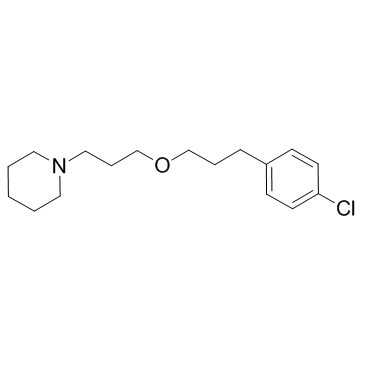
Pitolisant structure
|
Common Name | Pitolisant | ||
|---|---|---|---|---|
| CAS Number | 362665-56-3 | Molecular Weight | 295.84700 | |
| Density | N/A | Boiling Point | N/A | |
| Molecular Formula | C17H26ClNO | Melting Point | N/A | |
| MSDS | N/A | Flash Point | N/A | |
Use of PitolisantPitolisant is a potent and selective nonimidazole inverse agonist at the recombinant human histamine H3 receptor (Ki=0.16 nM). |
This table lists Chinese names, IUPAC names and various aliases of this chemical substance.
| Name | 1-[3-[3-(4-chlorophenyl)propoxy]propyl]piperidine |
|---|---|
| Synonym | More Synonyms |
This table contains bioactivity, target information and biological‑assay experimental data of this compound.
| Description | Pitolisant is a potent and selective nonimidazole inverse agonist at the recombinant human histamine H3 receptor (Ki=0.16 nM). |
|---|---|
| Related Catalog | |
| Target |
Ki: 0.16 nM (H3 receptor)[1] EC50: 1.5 nM (H3 receptor)[1] |
| In Vitro | On the stimulation of guanosine 5′-O-(3-[35S]thio)triphosphate binding to this receptor, Pitolisant (BF2.649) behaves as a competitive antagonist with a Ki value of 0.16 nM and as an inverse agonist with an EC50 value of 1.5 nM and an intrinsic activity ~50% higher than that of ciproxifan. Pitolisant displaces [125I]iodoproxyfan binding from mouse brain cortical membranes with an IC50 value of 26.4±4.5 nM. Taking into account the Kd value of the radioligand (161±9 pM), the deduced Ki value for Pitolisant is 14±1 nM. Pitolisant displaces [125I]iodoproxyfan binding from membranes of rat glioma C6 cells stably expressing the human H3 receptor with an IC50 value of 4.2±0.2 nM. Taking into account the Kd value of the radioligand (50±4 pM), the deduced Ki value for Pitolisant is 2.7±0.5 nM. Pitolisant progressively reverses this response with a Hill coefficient close to unity and an IC50 value of 330±68 nM, leading to a Ki value of 17±4 nM. Pitolisant elicits a dose-dependent decrease of the basal-specific [35S]GTPγS binding to membranes with a maximal effect corresponding to 75±1% of the basal-specific binding and an EC50 value of 1.5±0.1 nM[1]. |
| In Vivo | The administration of Pitolisantat a single dose of 10 mg/kg 30 min before a single dose of Olanzapine (2 mg/kg b.w.) also significantly affects immobility time in the FST. Subsequent administration of the aforementioned drug sequence in mice statistically significantly increases the duration of immobility in comparison to the time determined in the control group in the FST. It decreased locomotor activity as well. In contrast, the results obtained in subchronic treatment after fifteen administrations of both drugs (Pitolisant 10 mg/kg b.w., and after 30 min Olanzapine 2 mg/kg b.w., and again after 4 h Olanzapine 2 mg/kg b.w.) show that the administration of Pitolisant followed by that of Olanzapine equalized the locomotor activity in mice; in comparison to the level of motility in the control group, to which only Pitolisant is administered. More importantly, this combination of drugs significantly reduces immobility time to the level obtained in the control group in the forced swim test in mice [one-way ANOVA; F (3,20)=4.226,P=0.0181][2]. Rats given Pitolisant (10 mg/kg) during the conditioning phase stayed 502±94 s on the paired texture, a value not statistically different from that of controls, indicating that Pitolisant did not support place preference[3]. |
| Kinase Assay | [35S]GTPγS binding assays are performed. CHO-K1 cells stably expressing the human H3 receptor (~400 fmol/mg protein) are homogenized in ice-cold buffer (50 mM Tris/HCl, pH 7.4). Homogenates are centrifuged twice (20,000g for 10 min at 4°C), and the final pellet is resuspended in 50 volumes of buffer. Membranes (550 μg of protein) are pretreated with adenosine deaminase (1 U/mL) and incubated for 60 min at 25°C with 0.1 nM [35S]GTPγS and the drugs to be tested in a final volume of 1 mL of assay buffer (50 mM Tris/HCl, 50 mM NaCl, 5 mM MgCl2, 10 μM GDP, and 0.02% bovine serum albumin, pH 7.4). The nonspecific binding is determined using 10 μM nonradioactive GTPγS. Incubations are stopped by rapid filtration under vacuum through GF/B glass fiber filters. After washing with ice-cold water, the radioactivity trapped on filters is counted by liquid scintillation spectrometry. A similar assay is used to assess competitive antagonism. In brief, membranes (10 μg of protein) of HEK-293 cells stably expressing the human H3 receptor (~600 fmol/mg protein) are preincubated in presence of Pitolisant in the buffer (50 mM Tris/HCl, pH 7.4, 10 mM MgCl2, 100 mM NaCl, and 10 μM GDP) in a 96-well microplate under gentle agitation at room temperature (19-20°C) for 30 min before the addition of 0.1 nM [35S]GTPγS (final volume 200 μL). The nonspecific binding is determined using a 10 μM concentration of nonradioactive GTPγS. After 30 min, incubations performed in triplicate are stopped by rapid filtration under vacuum on a Multiscreen MAFCOB50 microplate. Radioactivity trapped on filters is counted by liquid scintillation spectrometry[1]. |
| Animal Admin | Mice[2] Adult female Albino Swiss mice weighing 20-22 g are used in the study. Olanzapine or Pitolisant are suspended in 1 % Tween 80. The compounds or vehicle are administered intraperitoneally (i.p.) 30 min prior to the acute experiment. In the Pitolisant+Olanzapine group, Pitolisant is administered 15 min before Olanzapine. Subchronic treatment is done at about 9:00 am (0.2 mL Tween to control group, Pitolisant-10 mg/kg b.w. to Pitolisant group, Olanzapine-2 mg/kg b.w. to Olanzapine group, Pitolisant-10 mg/kg b.w. and Olanzapine after 15 min-2 mg/kg b.w. to Pitolisant+Olanzapine group) and at about 1:00 pm (Olanzapine group and Pitolisant+Olanzapine group). Rats[3] Male Wistar rats (220-300 g) receive vehicle (methylcellulose 1%, p.o.), Pitolisant (10 mg/kg, p.o.) or D-amphetamine (2.5 mg/kg, i.p. in saline). Ninety minutes later, they are killed by decapitation and nucleus accumbens are dissected out, weighed, frozen in liquid nitrogen and stored at -80°C. Tissues are homogenized in 1 mL of a 0.4 N perchloric acid/2.7 mM EDTA solution. After centrifugation (8000 rpm, 20 min, 4°C), supernatants are analysed by HPLC coupled to electrochemical detection. Tissue concentrations of dopamine (DA), dihydroxyphenyl acetic acid (DOPAC) and homovanillic acid (HVA) are determined and the corresponding ratios (DOPAC/DA, HVA/DA) are calculated. |
| References |
This table shows physicochemical parameters including melting point, boiling point, density, solubility and optical rotation. Missing data is marked as N/A.
| Molecular Formula | C17H26ClNO |
|---|---|
| Molecular Weight | 295.84700 |
| Exact Mass | 295.17000 |
| PSA | 12.47000 |
| LogP | 4.10310 |
| InChIKey | NNACHAUCXXVJSP-UHFFFAOYSA-N |
| SMILES | Clc1ccc(CCCOCCCN2CCCCC2)cc1 |
This table presents publicly reported synthetic routes, reaction conditions, reactants and product information of the compound.
|
~99%
Pitolisant CAS#:362665-56-3 |
| Literature: FERRER INTERNACIONAL, S.A. Patent: WO2007/6708 A1, 2007 ; Location in patent: Page/Page column 4-5 ; |
|
~73%
Pitolisant CAS#:362665-56-3 |
| Literature: FERRER INTERNACIONAL, S. A. Patent: WO2006/84833 A1, 2006 ; Location in patent: Page/Page column 8 ; |
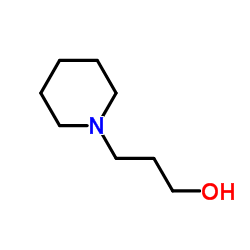
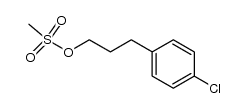
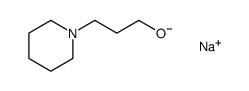
This table lists upstream starting materials and downstream derivative products related to this chemical.
| Precursor 2 | |
|---|---|
| DownStream 0 | |
This table contains target information, in‑vitro & in‑vivo assay data for this compound.
|
Name: Inhibition of human ERG expressed in CHO cells at holding potential of -90 mV by patc...
Source: ChEMBL
Target: Potassium voltage-gated channel subfamily H member 2
External Id: CHEMBL4433285
|
|
Name: Antiinflammatory activity in po dosed mouse brain assessed as activation in HA releas...
Source: ChEMBL
Target: Mus musculus
External Id: CHEMBL4219362
|
|
Name: Compound was evaluated for inhibition of rat Gabra1 in an in vitro assay with cellula...
Source: ChEMBL
Target: Gamma-aminobutyric acid receptor subunit alpha-1
External Id: CHEMBL5291801
|
|
Name: Binding affinity towards rat Gabra1 in an in vitro assay with cellular components mea...
Source: ChEMBL
Target: Gamma-aminobutyric acid receptor subunit alpha-1
External Id: CHEMBL5291798
|
|
Name: Displacement of [3H]-N-alpha-methylhistamine from human recombinant full length H3R e...
Source: ChEMBL
Target: Histamine H3 receptor
External Id: CHEMBL4433277
|
|
Name: Binding affinity towards human ESR1 in an in vitro cell free assay (NIBR assay) measu...
Source: ChEMBL
Target: Estrogen receptor
External Id: CHEMBL5291791
|
|
Name: Displacement of [3H]-N-alpha-methylhistamine from human histamine H3 receptor transfe...
Source: ChEMBL
Target: Histamine H3 receptor
External Id: CHEMBL5337072
|
|
Name: Reversal of RAMH-induced dipsogenia in Wistar rat (Krf:(WI) WU) assessed as inhibitio...
Source: ChEMBL
Target: Rattus norvegicus
External Id: CHEMBL4433280
|
|
Name: Cytotoxicity counterscreen for inhibitors of SARS-CoV-2 cell entry
Source: NCGC
Target: N/A
External Id: TRND-SARS-CoV-2-cytotox-48hr
|
This table collects all English aliases, systematic names and CAS‑related synonyms of the compound.
| 3-(4-chlorophenyl)propyl 3-piperidinopropyl ether |
| tiprolisant |
| Pitolisant |
| Pitolisant [INN] |
| 1-(3-(3-(4-chlorophenyl)propoxy)propyl)piperidine |
| UNII-4BC83L4PIY |
This section contains frequently‑asked‑questions about this compound, including basic parameters, properties, storage conditions and corresponding answers.
| Q: What is the molecular formula of 1-[3-[3-(4-chlorophenyl)propoxy]propyl]piperidine? |
| A: Molecular formula of 1-[3-[3-(4-chlorophenyl)propoxy]propyl]piperidine is C17H26ClNO. |
| Q: What are the upstream materials of 1-[3-[3-(4-chlorophenyl)propoxy]propyl]piperidine? |
| A: Related upstream materials(CAS) of 1-[3-[3-(4-chlorophenyl)propoxy]propyl]piperidine: 104-58-5;61440-60-6. |
| Q: What is the SMILES notation of 1-[3-[3-(4-chlorophenyl)propoxy]propyl]piperidine? |
| A: SMILES notation of 1-[3-[3-(4-chlorophenyl)propoxy]propyl]piperidine is Clc1ccc(CCCOCCCN2CCCCC2)cc1. |
| Q: What is the InChIKey of 1-[3-[3-(4-chlorophenyl)propoxy]propyl]piperidine? |
| A: InChIKey of 1-[3-[3-(4-chlorophenyl)propoxy]propyl]piperidine is NNACHAUCXXVJSP-UHFFFAOYSA-N. |
| Q: What is the Chinese name of 362665-56-3? |
| A: Chinese name of 362665-56-3 is Pitolisant. |
| Q: What are the uses of 1-[3-[3-(4-chlorophenyl)propoxy]propyl]piperidine? |
| A: Main uses of 1-[3-[3-(4-chlorophenyl)propoxy]propyl]piperidine: Pitolisant is a potent and selective nonimidazole inverse agonist at the recombinant human histamine H3 receptor (Ki=0.16 nM). |
| Q: What English synonyms does 1-[3-[3-(4-chlorophenyl)propoxy]propyl]piperidine have? |
| A: English synonyms of 1-[3-[3-(4-chlorophenyl)propoxy]propyl]piperidine: 3-(4-chlorophenyl)propyl 3-piperidinopropyl ether, tiprolisant, Pitolisant, Pitolisant [INN], 1-(3-(3-(4-chlorophenyl)propoxy)propyl)piperidine, UNII-4BC83L4PIY. |
| Q: What is the English name of 1-[3-[3-(4-chlorophenyl)propoxy]propyl]piperidine? |
| A: The English name of 1-[3-[3-(4-chlorophenyl)propoxy]propyl]piperidine is 1-[3-[3-(4-chlorophenyl)propoxy]propyl]piperidine. |
| Q: What is the polar surface area (PSA) of 1-[3-[3-(4-chlorophenyl)propoxy]propyl]piperidine? |
| A: Polar surface area (PSA) of 1-[3-[3-(4-chlorophenyl)propoxy]propyl]piperidine is 12.47000. |
| Q: What is the CAS number of 1-[3-[3-(4-chlorophenyl)propoxy]propyl]piperidine? |
| A: CAS number of 1-[3-[3-(4-chlorophenyl)propoxy]propyl]piperidine is 362665-56-3. |
This table lists manufacturers and suppliers of this compound, including vendor names and product supply reference information.
| Shanghai Nianxing Industrial Co., Ltd |
| Dayang Chem (Hangzhou) Co., Ltd. |
| Henan Tianfu Chemical Co., Ltd. |