CCCP
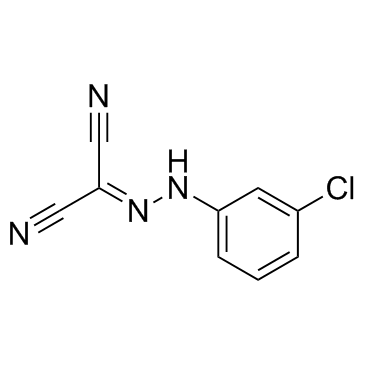
CCCP structure
|
Common Name | CCCP | ||
|---|---|---|---|---|
| CAS Number | 555-60-2 | Molecular Weight | 204.61600 | |
| Density | 1.26 g/cm3 | Boiling Point | 318.3ºC at 760 mmHg | |
| Molecular Formula | C9H5ClN4 | Melting Point | 170-175 °C (dec.) | |
| MSDS | Chinese USA | Flash Point | 146.3ºC | |
| Symbol |

GHS06 |
Signal Word | Danger | |
Use of CCCPCCCP is an oxidative phosphorylation uncoupler. |
This table lists Chinese names, IUPAC names and various aliases of this chemical substance.
| Name | cccp |
|---|---|
| Synonym | More Synonyms |
This table contains bioactivity, target information and biological‑assay experimental data of this compound.
| Description | CCCP is an oxidative phosphorylation uncoupler. |
|---|---|
| Related Catalog | |
| Target |
STING[1] IFN-β[1] |
| In Vitro | CCCP inhibits IFN-β production induced by various types of the STING pathway activators. CCCP suppresses the phosphorylation of STING, TBK1, and IRF3 via disrupting the association of STING and TBK1. CCCP inhibits activation of STING and its downstream signaling molecules, TBK1 and IRF3, but not STING translocation to the perinuclear region. CCCP impairs the interaction between STING and TBK1 and concomitantly triggers mitochondria fission. Importantly, the knockout of the crucial mitochondria fission regulator Drp1 restored the STING activity, indicating that CCCP down-modulates the STING pathway through DRP1-mediated mitochondria fragmentation. The protonophore CCCP that disrupts membrane potential suppresses the DMXAA-triggered STING signaling pathway. CCCP drastically suppresses the production of IFN-β in DMXAA-treated RAW264.7 cells and MEFs[1]. |
| In Vivo | The same dosage of 3 mg/kg.bw each of CCCP and PPEF is used. In both the cases 1 log reduction is observed in the bacterial load. However, when 3 mg/kg.bw of PPEF is used in combination with 3 mg/kg.bw of CCCP, 6 log10 reduction is observed in the bacterial count. The developed model validates the enhanced antibacterial activity of combination therapy[2].99mTc-MIBI signals in the hearts of SD rats administered CCCP (4 mg/kg intraperitoneally) or vehicle is also measured. 99mTc-MIBI signals decrease in rat hearts administered CCCP, and the ATP content, as measured by 31P magnetic resonance spectroscopy, decreased simultaneously. To investigate whether CCCP decreased the 99mTc-MIBI signals in rats, we analyzed the radioisotope activity of excised heart tissue from rats administered CCCP. At 180 min after 99mTc-MIBI injection, the 99mTc-MIBI signals from the hearts in the CCCP group are significantly lower than those in the vehicle group[3]. |
| Cell Assay | MEFs (5×10⁵), Raw264.7 cells (1×10⁶), and HeLa cells stable expressing STING (1.5×10⁵) are stimulated with DMXAA (100 μg/mL) for 2 or 3 h, or transfected with c-di-GMP (5 μM), cGAMP (5 μg/mL), or poly (dA:dT) (2 μg/mL) for 6 h. CCCP (50 μM) is co-treated with DMXAA (100 μg/mL), or treated for the last 5 h in case of treatment of c-di-GMP or poly (dA:dT)[1]. |
| Animal Admin | Mice[2] Female Balb/c mice n=6, per dosing group weighing 20-25 g are rendered neutropenic with 2 intraperitoneal injections of cyclophosphamide 150 mg/kg.bw and 100 mg/kg.bw on 4 days and 1 day prior to bacterial infection. 0.1 mL of the 106 CFU/mL bacterial suspension is injected into right posterior thigh muscle. After 2 h post-infection mice are treated with PPEF (3 mg/kg.bw), CCCP (3 mg/kg.bw) and in combination PPEF+CCCP (3 mg/kg.bw+3 mg/kg.bw) dissolved in 0.1 mL sterile water by single bolus intravenous injection. Twenty-four hours after antibacterial administration, the mice are humanely sacrificed. Right thigh muscles from each mouse are aseptically collected, homogenized and serially diluted and processed for quantitative cultures. Rats[3] Rats are randomly divided into three groups. One group is euthanized 15 min after a dose of 12.5 MBq (337.8 μCi) 99mTc-MIBI injection (n=6). The other two groups are administered 4 mg/kg CCCP (CCCP group; n=7) or vehicle (vehicle group; n=7) by intraperitoneal (i.p.) injection 90 min after the same dose of 99mTc-MIBI injection and are euthanized after an additional 90 min (180 min after the 99mTc-MIBI injection). Hearts are excised and weighed, and radioactivity is measured between 110 and 170 keV with an auto-well gamma counter. 99mTc-MIBI signals are corrected for physical decay (half-life=6 h). |
| References |
This table shows physicochemical parameters including melting point, boiling point, density, solubility and optical rotation. Missing data is marked as N/A.
| Density | 1.26 g/cm3 |
|---|---|
| Boiling Point | 318.3ºC at 760 mmHg |
| Melting Point | 170-175 °C (dec.) |
| Molecular Formula | C9H5ClN4 |
| Molecular Weight | 204.61600 |
| Flash Point | 146.3ºC |
| Exact Mass | 204.02000 |
| PSA | 71.97000 |
| LogP | 2.22806 |
| Index of Refraction | 1.611 |
| InChIKey | UGTJLJZQQFGTJD-UHFFFAOYSA-N |
| SMILES | N#CC(C#N)=NNc1cccc(Cl)c1 |
| Storage condition | 2-8°C |
| Water Solubility | methanol: 10 mg/mL, clear, very deep yellow |
This table provides MSDS information including hazard classification, first‑aid, fire‑fighting, spill handling, operation and storage instructions.
This table covers safety warnings, protective measures, incompatible substances and disposal guidelines for this compound.
| Symbol |
GHS06 |
|---|---|
| Signal Word | Danger |
| Hazard Statements | H301 + H311 + H331-H315-H319-H335 |
| Precautionary Statements | P261-P280-P301 + P310-P305 + P351 + P338-P311 |
| Personal Protective Equipment | Eyeshields;Faceshields;Gloves;type P2 (EN 143) respirator cartridges |
| Hazard Codes | T: Toxic; |
| Risk Phrases | R23/24/25 |
| Safety Phrases | S26-S36/37-S45 |
| RIDADR | UN 2811 6.1/PG 3 |
| WGK Germany | 3 |
| RTECS | FG5600000 |
| Packaging Group | III |
| Hazard Class | 6.1 |
| HS Code | 2928000090 |
This table lists upstream starting materials and downstream derivative products related to this chemical.
| Precursor 1 | |
|---|---|
| DownStream 0 | |
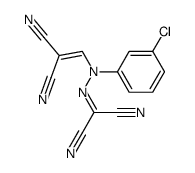 CAS#:68657-31-8
This table shows customs‑related data including HS‑code, tariff and regulatory conditions for import and export.
| HS Code | 2928000090 |
|---|---|
| Summary | 2928000090 other organic derivatives of hydrazine or of hydroxylamine VAT:17.0% Tax rebate rate:9.0% Supervision conditions:none MFN tariff:6.5% General tariff:20.0% |
This table lists relevant public references with title, journal and publication metadata for this compound.
|
Mitochondrial dynamics regulate melanogenesis through proteasomal degradation of MITF via ROS-ERK activation.
Pigment Cell Melanoma Res. 27(6) , 1051-62, (2014) Mitochondrial dynamics control mitochondrial functions as well as their morphology. However, the role of mitochondrial dynamics in melanogenesis is largely unknown. Here, we show that mitochondrial dy... |
|
|
The Ca²⁺-calmodulin-Ca²⁺/calmodulin-dependent protein kinase II signaling pathway is involved in oxidative stress-induced mitochondrial permeability transition and apoptosis in isolated rat hepatocytes.
Arch. Toxicol. 88(9) , 1695-709, (2014) Oxidative stress (OS) is a common event in most hepatopathies, leading to mitochondrial permeability transition pore (MPTP) formation and further exacerbation of both OS from mitochondrial origin and ... |
|
|
Higher vulnerability and stress sensitivity of neuronal precursor cells carrying an alpha-synuclein gene triplication.
PLoS ONE 9(11) , e112413, (2014) Parkinson disease (PD) is a multi-factorial neurodegenerative disorder with loss of dopaminergic neurons in the substantia nigra and characteristic intracellular inclusions, called Lewy bodies. Geneti... |
This table contains target information, in‑vitro & in‑vivo assay data for this compound.
This table collects all English aliases, systematic names and CAS‑related synonyms of the compound.
| MFCD00001848 |
| EINECS 209-103-7 |
| 2-[(3-chlorophenyl)hydrazinylidene]propanedinitrile |
| CARBONYL CYANIDE 3-CHLOROPHENYLHYDRAZONE |
This section contains frequently‑asked‑questions about this compound, including basic parameters, properties, storage conditions and corresponding answers.
| Q: What are the upstream materials of cccp? |
| A: Related upstream materials(CAS) of cccp: 68657-31-8. |
| Q: What are the storage conditions for cccp? |
| A: Storage conditions for cccp: 2-8°C. |
| Q: What is the CAS number of cccp? |
| A: CAS number of cccp is 555-60-2. |
| Q: What is the InChIKey of cccp? |
| A: InChIKey of cccp is UGTJLJZQQFGTJD-UHFFFAOYSA-N. |
| Q: What is the SMILES notation of cccp? |
| A: SMILES notation of cccp is N#CC(C#N)=NNc1cccc(Cl)c1. |
| Q: What is the molecular formula of cccp? |
| A: Molecular formula of cccp is C9H5ClN4. |
| Q: What is the English name of cccp? |
| A: The English name of cccp is cccp. |
| Q: What English synonyms does cccp have? |
| A: English synonyms of cccp: MFCD00001848, EINECS 209-103-7, 2-[(3-chlorophenyl)hydrazinylidene]propanedinitrile, CARBONYL CYANIDE 3-CHLOROPHENYLHYDRAZONE. |
| Q: What is the melting point of cccp? |
| A: Melting point of cccp is 170-175 °C (dec.). |
| Q: What is the LogP of cccp? |
| A: LogP of cccp is 2.22806. |
This table lists manufacturers and suppliers of this compound, including vendor names and product supply reference information.
| Shanghai Nianxing Industrial Co., Ltd |
| Dayang Chem (Hangzhou) Co., Ltd. |