Cyclodextrins as carriers for kavalactones in aqueous media: spectroscopic characterization of (S)-7,8-dihydrokavain and beta-cyclodextrin inclusion complex.
G Pescitelli, A R Bilia, M C Bergonzi, F F Vincieri, L Di Bari
Index: J. Pharm. Biomed. Anal. 52(4) , 479-83, (2010)
Full Text: HTML
Abstract
Kavalactones represent the active constituents of kava-kava (Piper methysticum G. Forster), endowed with sedative and anaesthetic properties. Kavalactones are polar constituents, but poorly soluble in water with a low bioavailability. In this study, the formation of inclusion complexes of one of the most representative kavalactone isolated from kava-kava extract, (S)-7,8-dihydrokavain (DHK), with beta-cyclodextrin (beta-CyD) was investigated mainly by spectroscopic methods. NMR experiments were extensively used for the complete characterization of the complex and included (1)H NMR complexation shifts analysis, (1)H NMR diffusion measurements (DOSY), and ROESY experiments. In particular DOSY experiments demonstrated that in the presence of beta-CyD the translational diffusion of kavalactone is sizably slowed down (2.5x10(-10)m(2)/s) with respect to the free drug (4.4x10(-10)m(2)/s) according to the inclusion of DHK in the cavity of (beta-CyD). ROESY experiments confirmed the inclusion of DHK in the hydrophobic pocket of beta-CyD through the primary hydroxyl rim, being the most relevant interactions between the H3' of beta-CyD and the ortho protons on the phenyl ring of the DHK, and between H5' of beta-CyD and the meta/para protons of DHK phenyl ring. The inclusion of the phenyl ring of DHK, leaving the lactone moiety outside of CyD was also confirmed by the induced CD effects. The binary solution DHK/beta-CyD shows a 50% intensity increase of the negative band of the pi-pi* transitions of the phenyl ring with respect to the absorption observed with DHK alone. Molecular dynamics simulations results corroborated and further clarify observed spectroscopic data. It was found that the phenylethyl substituent at C6 has a preferential equatorial position in the free state, and an axial one in the complex, justifying the large downfield shift experienced by H6 of DHK upon binding. Finally the influence of beta-CyD on water solubility of DHK was investigated by phase-solubility studies. In the range 2-4mM of host, solubility of DHK was increased only two-fold, but being beta-CyD also a penetration enhancer, in vivo studies will be performed to clarify a possible role of the complex on the bioavailability of DHK.Copyright (c) 2010 Elsevier B.V. All rights reserved.
Related Compounds
| Structure | Name/CAS No. | Molecular Formula | Articles |
|---|---|---|---|
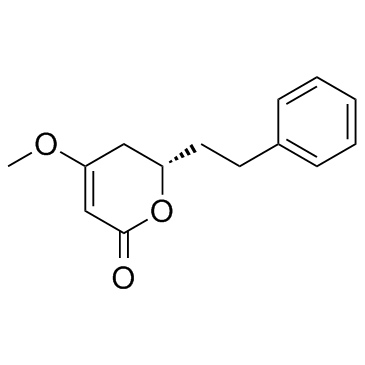 |
Dihydrokavain
CAS:587-63-3 |
C14H16O3 |
|
Interaction of various Piper methysticum cultivars with CNS ...
2001-06-01 [Planta Med. 67(4) , 306-11, (2001)] |
|
Determination of six kavalactones in dietary supplements and...
2005-01-01 [J. AOAC Int. 88(1) , 16-25, (2005)] |
|
Glial dysfunction in the mouse habenula causes depressive-li...
2014-12-03 [J. Neurosci. 34(49) , 16273-85, (2014)] |
|
Identification and characterization of kava-derived compound...
2009-08-01 [Chem. Biol. Drug Des. 74(2) , 121-8, (2009)] |
|
Efficient enantioselective hetero-Diels-Alder reaction of Br...
2008-03-20 [Org. Lett. 10(6) , 1311-4, (2008)] |