Journal of Physical Chemistry A: Molecules, Spectroscopy, Kinetics, Environment and General Theory 2011-07-28

Comparison of the photochemical behaviors of α-tocopherol and its acetate in organic and aqueous micellar solutions.

Ye Zhang, Y A Yousef, Heng Li, T B Melø, K Razi Naqvi

Index: J. Phys. Chem. A 115 , 8242-8247, (2011)

Full Text: HTML

Abstract

Photoionization is known to take place when α-tocopherol (TOH) is excited to the S(1) state in a polar medium. It has been previously suggested that TO(•) is formed only as a result of proton release by TOH(•+), a process that is expected to occur, in a protic solvent, on the subnanosecond time scale. Recent redeterminations of the molar absorption coefficients of e(aq)(–) (Hare J. Phys. Chem. A 2010, 114, 1766) and of TOH(•+) and TO(•) (Naqvi J. Phys. Chem. A 2010, 114, 10795) have paved the way for testing the above suggestion, even if subnanosecond time resolution is not available, since it implies the equality of [e(aq)(–)](0) and [TO(•)](0), where [···](0) denotes the concentration of the enclosed species immediately after a nanosecond laser pulse. Nanosecond pump-probe spectroscopy of TOH in aqueous micellar solution (AMS) and two organic solvents with similar polarities (acetonitrile and methanol) has revealed that prompt formation of TO(•) through dissociation (TOH + hν → TO(•) + H(•)) is not negligible even in AMS. In acetonitrile, TOH(•+) and TO(•) are formed with comparable yields, and the former converts quantitatively into TO(•) within 15 μs. In methanol, TO(•) was observed, but no evidence was found for electron ejection from TOH. Only one photoproduct, namely TO(•), could be detected when α-tocopherol acetate (TOAc) was excited to the S(1) state in several polar and nonpolar solvents; TOAc has been found to be a more efficient energy degrader than TOH.© 2011 American Chemical Society

Related Compounds

Structure Name/CAS No. Articles
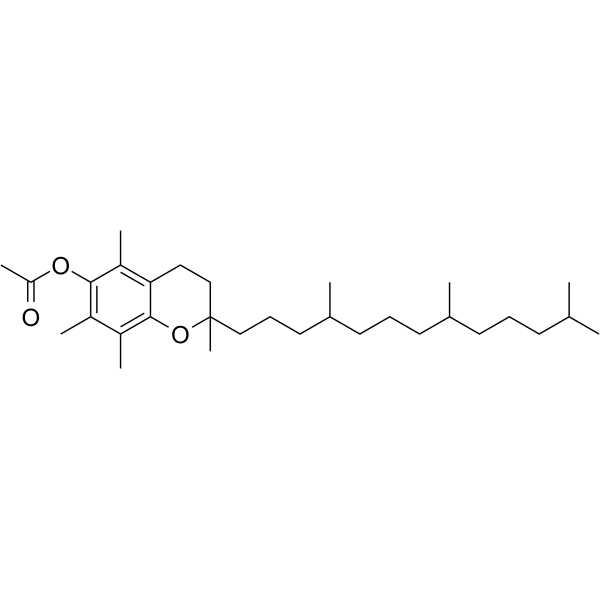
Tocopheryl acetate Structure Tocopheryl acetate
CAS:7695-91-2
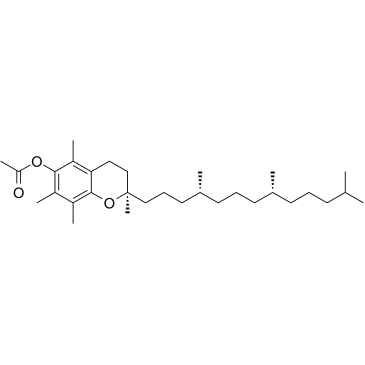
alpha-Tocopherol acetate Structure alpha-Tocopherol acetate
CAS:58-95-7