Biosynthesis of 15-deoxy-delta12,14-PGJ2 and the ligation of PPARgamma.
L Chastine Bell-Parikh, Tomomi Ide, John A Lawson, Peter McNamara, Muredach Reilly, Garret A FitzGerald
Index: J. Clin. Invest. 112(6) , 945-55, (2003)
Full Text: HTML
Abstract
15-deoxy-Delta12,14-PGJ2 (15d-PGJ2) has been identified as an endogenous ligand for PPARgamma, inducing adipogenesis in vitro. Additional roles for this molecule in the propagation and resolution of inflammation, ligation of NF-kappaB, and mediation of apoptosis have been proposed. However, quantitative, physiochemical evidence for the formation of 15d-PGJ2 in vivo is lacking. We report that 15d-PGJ2 is detectable using liquid chromatography-mass spectrometry-mass spectrometry at low picomolar concentrations in the medium of 3T3-L1 preadipocytes. However, despite induction of COX-2, production of PGs, including 15d-PGJ2, does not increase during adipocyte differentiation, a process unaltered by COX inhibition. 15d-PGJ2 is detectable as a minor product of COX-2 in human urine. However, its biosynthesis is unaltered during or after COX activation in vivo by LPS. Furthermore, the biosynthesis of 15d-PGJ2 is not augmented in the joint fluid of patients with arthritis, nor is its urinary excretion increased in patients with diabetes or obesity. 15d-PGJ2 is not the endogenous mediator of PPARgamma-dependent adipocyte activation and is unaltered in clinical settings in which PPARgamma activation has been implicated.
Related Compounds
| Structure | Name/CAS No. | Molecular Formula | Articles |
|---|---|---|---|
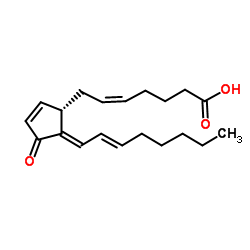 |
15-Deoxy-Delta12
CAS:87893-55-8 |
C20H28O3 |
|
HMDB: a knowledgebase for the human metabolome.
2009-01-01 [Nucleic Acids Res. 37(Database issue) , D603-10, (2009)] |
|
The human serum metabolome.
2011-01-01 [PLoS ONE 6(2) , e16957, (2011)] |
|
Lipidomics reveals a remarkable diversity of lipids in human...
2010-11-01 [J. Lipid Res. 51(11) , 3299-305, (2010)] |
|
Calcium-responsive transactivator (CREST) protein shares a s...
2015-01-01 [Molecular Neurodegeneration 10 , 20, (2015)] |
|
Raphe-mediated signals control the hippocampal response to S...
2011-01-01 [Transl. Psychiatry 1 , e56, (2012)] |