Structure and properties of methacrylate-endcapped caprolactone networks with modulated water uptake for biomedical applications.
J L Escobar Ivirico, E Costa Martínez, M Salmerón Sánchez, I Muñoz Criado, J L Gómez Ribelles, M Monleón Pradas
Index: J. Biomed. Mater. Res. B. Appl. Biomater. 83(1) , 266-75, (2007)
Full Text: HTML
Abstract
Methacrylate-endcapped caprolactone (CLMA) networks were synthesized and copolymerized with 2-hydroxyethyl acrylate (HEA) seeking to tailor the hydrophilicity of the system. The resulting structure of the copolymer network is investigated by differential scanning calorimetry, thermogravimetry, and Fourier transform infrared spectroscopy. The dynamic swelling behavior and the equilibrium water sorption is measured and correlated with the microstructure. The experimental results allow one to conclude that the new material is a random copolymer of both components, HEA and CLMA. The effect of cell attachment and proliferation on the new copolymer networks was observed by in vitro culture of human chondrocytes up to 8 days. Enhanced cellular adhesion, similar to that obtained with tissue culture polystyrene (TCPS), was obtained in the hydrophilized systems. The new copolymers are appropriate for the fabrication of scaffolds with controlled porosity for tissue engineering.
Related Compounds
| Structure | Name/CAS No. | Molecular Formula | Articles |
|---|---|---|---|
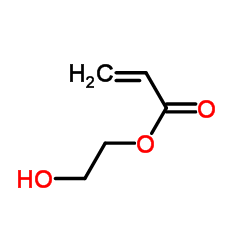 |
2-Hydroxyethyl acrylate
CAS:818-61-1 |
C5H8O3 |
|
Micro-computed tomography image-based evaluation of 3D aniso...
2015-01-01 [Comput. Methods Biomech. Biomed. Engin. 18(4) , 446-55, (2014)] |
|
Neural tissue regeneration in experimental brain injury mode...
2015-06-26 [Neurosci. Lett. 598 , 96-101, (2015)] |
|
Photopatterned oil-reservoir micromodels with tailored wetti...
2015-07-21 [Lab Chip 15 , 3047-55, (2015)] |
|
Combined application of polyacrylate scaffold and lipoic aci...
2016-01-01 [Brain Inj. 30 , 208-16, (2016)] |
|
Hydroxamic acid-containing hydrogels for nonabsorbed iron ch...
2005-01-01 [Biomacromolecules 6(6) , 2946-53, (2005)] |