The fate of N-methyl-N'-(hydroxymethyl)thiourea in the rat.
A R Jones, P M Mashford
Index: Xenobiotica 13(2) , 73-9, (1983)
Full Text: HTML
Abstract
1. The fate of N-methyl-N'-(hydroxy[14C]methyl)thiourea (MHT) has been studied in the male Sprague-Dawley rat. The compound is degraded to N-methylthiourea and formaldehyde. 2. N-Methylthiourea is excreted as a urinary metabolite whereas the formaldehyde is not excreted, either in the urine or the expired air, but is metabolized via formate to CO2. 3. At least 50% of an i.p. dose (100 mg/kg) of MHT is excreted unchanged and some of this undergoes hydrolysis within the urine to N-methylthiourea and formaldehyde. Production of formaldehyde leads to the formation of the urinary artefact N-(hydroxymethyl)urea. 4. Tissue-distribution studies with 14C-MHT have shown that radioactivity is selectively associated with the thyroid gland. A preliminary investigation has indicated that MHT has anti-thyroid hormone activity as it lowers the thyroxine in rat serum.
Related Compounds
| Structure | Name/CAS No. | Molecular Formula | Articles |
|---|---|---|---|
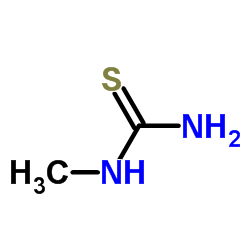 |
N-Methylthiourea
CAS:598-52-7 |
C2H6N2S |
|
Endothelial nitric oxide synthase deficient mice are protect...
2015-01-01 [PLoS ONE 10(3) , e0119918, (2015)] |
|
Metabolism of 4-[1-(2-fluoro-4-biphenylyl)ethyl]-2-methylami...
1997-01-01 [Eur. J. Drug Metab. Pharmacokinet. 22(1) , 25-33, (1997)] |
|
[Proper use of noxythiolin: an experimental rat study on int...
1980-01-01 [Therapie. 35(3) , 409-12, (1980)] |
|
PPAR-γ regulates carnitine homeostasis and mitochondrial fun...
2012-01-01 [PLoS ONE 7(9) , e41555, (2012)] |
|
Ameliorative effects of taurine against methimazole-induced ...
2012-12-01 [Sci. Pharm. 80 , 987-99, (2012)] |