Contaminations of herbal products determined by NMR fingerprint.
Marcello Nicoletti, Valentina Petitto
Index: Nat. Prod. Res. 24(14) , 1325-9, (2010)
Full Text: HTML
Abstract
The utilisation of NMR fingerprinting is proposed as a rapid, available and reliable method to determine the contamination of herbal products. The presence of nimesulide has been reported recently as the contaminant of P.C. 28 Plus, a product based on herbal drugs marketed by the Italian company Cosval. The presence of the substance, as well as its relevant concentration (5%), was first reported by HPLC/MS analysis by other authors. The use of an NMR fingerprint confirmed the previous contamination with nimesulide in P.C. 28 Plus. The same contaminant was also found in P.C. 28 Pink. Furthermore, an analysis of Alergix Plus, another product of the same factory, evidenced the presence of bromhexin.
Related Compounds
| Structure | Name/CAS No. | Molecular Formula | Articles |
|---|---|---|---|
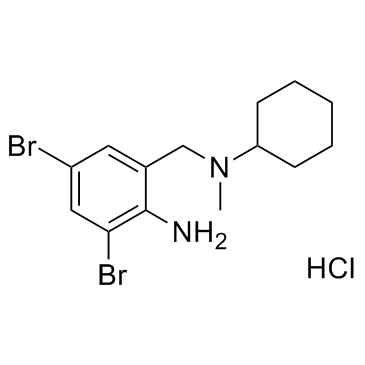 |
Bromhexine hydrochloride
CAS:611-75-6 |
C14H21Br2ClN2 |
|
Investigation of internal structure of fine granules by micr...
2013-03-10 [Int. J. Pharm. 445(1-2) , 93-8, (2013)] |
|
Structural changes of polymer-coated microgranules and excip...
2015-03-15 [Int. J. Pharm. 481(1-2) , 132-9, (2015)] |
|
Predicting prognosis in idiopathic pulmonary fibrosis.
2010-07-01 [Sarcoidosis Vasc. Diffuse Lung Dis. 27(2) , 85-95, (2010)] |
|
Superior mesenteric artery aneurysm: importance of sonograph...
2010-10-01 [J. Ultrasound Med. 29(10) , 1503-6, (2010)] |
|
Solubility and solution stability studies of different amino...
2012-11-01 [Drug Dev. Ind. Pharm. 38(11) , 1319-27, (2012)] |