Nature and role of proteasomes in maturation of fish oocytes.
T Tokumoto
Index: Int. Rev. Cytol. 186 , 261-94, (1999)
Full Text: HTML
Abstract
The proteasome is an essential component of the proteolytic pathway in eukaryotic cells and is responsible for the degradation of most cellular proteins. Proteasomes are sorted into two types, 20S and 26S. The 20S proteasome forms the catalytic core of the 26S proteasome. The 26S proteasome is involved in the ubiquitin-dependent protein degradation pathway. Cyclins and cdk inhibitors or c-mos products, proteins critical to the regulation of the cell cycle, are known to be degraded by the ubiquitin pathway. Thus the 26S proteasome is thought to be involved in the regulation of cell cycle events. This review focuses on advances in the study of the biochemical properties and functions of the 20S and 26S proteasomes in the fish meiotic cell cycle.
Related Compounds
| Structure | Name/CAS No. | Molecular Formula | Articles |
|---|---|---|---|
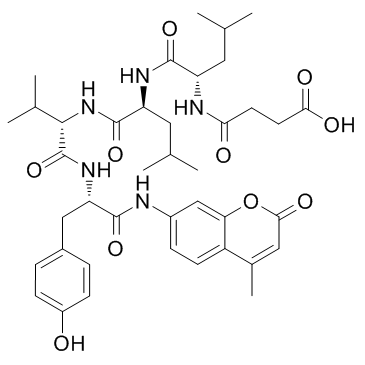 |
Suc-Leu-Leu-Val-Tyr-AMC
CAS:94367-21-2 |
C40H53N5O10 |
|
Human high temperature requirement serine protease A1 (HTRA1...
2012-06-15 [J. Biol. Chem. 287(25) , 20931-41, (2012)] |
|
Turnover of oxidatively damaged nuclear proteins in BV-2 mic...
2001-06-01 [FASEB J. 15(8) , 1460-2, (2001)] |
|
Activation of the cell death program by nitric oxide involve...
1999-07-09 [J. Biol. Chem. 274(28) , 19581-6, (1999)] |
|
Differential impairment of 20S and 26S proteasome activities...
2000-05-01 [Arch. Biochem. Biophys. 377(1) , 65-8, (2000)] |
|
The Leishmania mexicana proteasome.
1999-09-20 [Mol. Biochem. Parasitol. 103(1) , 49-60, (1999)] |