Highly efficient capture and long-term encapsulation of dye by catanionic surfactant vesicles.
Xiang Wang, Emily J Danoff, Nikolai A Sinkov, Jae-Ho Lee, Srinivasa R Raghavan, Douglas S English
Index: Langmuir 22(15) , 6461-4, (2006)
Full Text: HTML
Abstract
Vesicles formed from the cationic surfactant, cetyltrimethylammonium tosylate (CTAT) and the anionic surfactant, sodium dodecylbenzenesulfonate (SDBS), were used to sequester the anionic dye carboxyfluorescein. Carboxyfluorescein was efficiently sequestered in CTAT-rich vesicles via two mechanisms: encapsulation in the inner water pool and electrostatic adsorption to the charged bilayer. The apparent encapsulation efficiency (22%) includes both encapsulated and adsorbed fractions. Entrapment of carboxyfluorescein by SDBS-rich vesicles was not observed. Results show the permeability of the catanionic membrane is an order of magnitude lower than that of phosphatidylcholine vesicles and the loading capacity is more than 10 times greater.
Related Compounds
| Structure | Name/CAS No. | Molecular Formula | Articles |
|---|---|---|---|
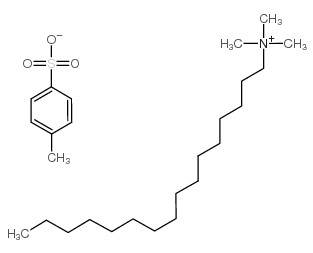 |
Hexadecyltrimethylammonium p-toluenesulfonate
CAS:138-32-9 |
C26H49NO3S |
|
Magnetic mesoporous silica nanoparticles for potential deliv...
2014-11-07 [Dalton Trans. 43(41) , 15482-90, (2014)] |
|
Engineering poly(ethylene glycol) particles for improved bio...
2015-02-24 [ACS Nano 9(2) , 1571-80, (2015)] |
|
Dispersion of single-walled carbon nanotubes of narrow diame...
2005-08-04 [J. Phys. Chem. B 109 , 14454, (2005)] |
|
[Analysis of a new toothpaste].
[Odontostomatol. Implantoprotesi (4) , 17-9, (1981)] |
|
Spontaneous vesicle formation in aqueous mixtures of single-...
1989-09-22 [Science 245(4924) , 1371-4, (1989)] |