Food Chemistry 2016-03-01

Fatty acids attached to all-trans-astaxanthin alter its cis-trans equilibrium, and consequently its stability, upon light-accelerated autoxidation.

Wouter J C de Bruijn, Yannick Weesepoel, Jean-Paul Vincken, Harry Gruppen

Index: Food Chem. 194 , 1108-15, (2015)

Full Text: HTML

Abstract

Fatty acid esterification, common in naturally occurring astaxanthin, has been suggested to influence both colour stability and degradation of all-trans-astaxanthin. Therefore, astaxanthin stability was studied as influenced by monoesterification and diesterification with palmitate. Increased esterification decelerated degradation of all-trans-astaxanthin (RP-UHPLC-PDA), whereas, it had no influence on colour loss over time (spectrophotometry). This difference might be explained by the observation that palmitate esterification influenced the cis-trans equilibrium. Free astaxanthin produced larger amounts of 9-cis isomer whereas monopalmitate esterification resulted in increased 13-cis isomerization. The molar ratios of 9-cis:13-cis after 60min were 1:1.7 (free), 1:4.8 (monopalmitate) and 1:2.6 (dipalmitate). The formation of 9-cis astaxanthin, with its higher molar extinction coefficient than that of all-trans-astaxanthin, might compensate for colour loss induced by conjugated double bond cleavage. As such, it was concluded that spectrophotometry is not an accurate measure of the degradation of the all-trans-astaxanthin molecule.Copyright © 2015 Elsevier Ltd. All rights reserved.

Related Compounds

Structure Name/CAS No. Articles
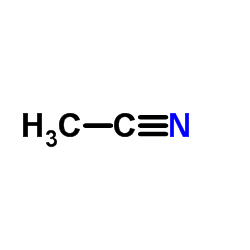
Acetonitrile Structure Acetonitrile
CAS:75-05-8
Hydrogen iodide Structure Hydrogen iodide
CAS:10034-85-2
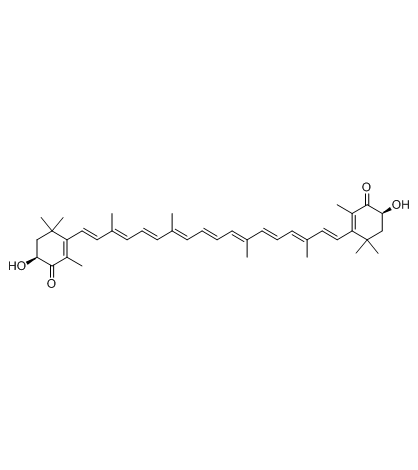
Astaxanthin Structure Astaxanthin
CAS:472-61-7