Pinacidil enhances survival of cryopreserved human embryonic stem cells
Ivana Barbaric, Mark Jones, Kristina Buchner, Duncan Baker, Peter W. Andrews, Harry D. Moore
文献索引:Cryobiology 63(3) , 298-305, (2011)
全文:HTML全文
摘要
Human embryonic stem cells (hESCs) can be maintained as undifferentiated cells in vitro and induced to differentiate into a variety of somatic cell types. Thus, hESCs provide a source of differentiated cell types that could be used to replace diseased cells of a tissue. The efficient cryopreservation of hESCs is important for establishing effective stem cell banks, however, conventional slow freezing methods usually lead to low rates of recovery after thawing cells and their replating in culture. We have established a method for recovering cryopreserved hESCs using pinacidil and compared it to a method that employs the ROCK inhibitor Y-27632. We show that pinacidil is similar to Y-27632 in promoting survival of hESCs after cryopreservation. The cells exhibited normal hESC morphology, retained a normal karyotype, and expressed characteristic hESC markers (OCT4, SSEA3, SSEA4 and TRA-1-60). Moreover, the cells retained the capacity to differentiate into derivatives of all three embryonic germ layers as demonstrated by differentiation through embryoid body formation. Pinacidil has been used for many years as a vasodilator drug to treat hypertension and its manufacture and traceability are well defined. It is also considerably cheaper than Y-27632. Thus, the use of pinacidil offers an efficient method for recovery of cryopreserved dissociated human ES cells.
相关化合物
| 结构式 | 名称/CAS号 | 分子式 | 全部文献 |
|---|---|---|---|
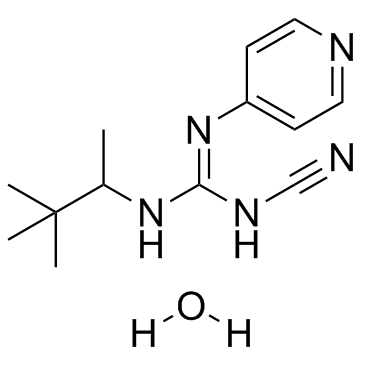 |
吡那地尔
CAS:85371-64-8 |
C13H21N5O |
|
Evidence against a systemic arterial defect in patients with...
2014-10-01 [J. Surg. Res. 191(2) , 318-22, (2014)] |
|
Kcnh2 and Kcnj8 interactively regulate skin wound healing an...
2015-01-01 [Wound Repair Regen. 23 , 797-806, (2015)] |
|
Potassium ion channels and allergic asthma.
2015-01-01 [Adv. Exp. Med. Biol. 838 , 35-45, (2015)] |
|
CYP-epoxygenases contribute to A2A receptor-mediated aortic ...
2012-11-15 [Am. J. Physiol. Regul. Integr. Comp. Physiol. 303(10) , R1003-10, (2012)] |
|
Hypoxia and reoxygenation modulate the arrhythmogenic activi...
2012-02-01 [Clin. Sci. 122(3) , 121-32, (2012)] |