Utilization of capsaicin and vanillylamine as growth substrates by Capsicum (hot pepper)-associated bacteria.
Suvi F Flagan, Jared R Leadbetter
文献索引:Environ. Microbiol. 8(3) , 560-5, (2006)
全文:HTML全文
摘要
Capsaicin contributes to the organoleptic attributes of hot peppers. Here, we show that capsaicin is utilized as a growth nutrient by certain bacteria. Enrichment cultures utilizing capsaicin were successfully initiated using Capsicum-derived plant material or leaves of tomato (a related Solanaceae) as inocula. No other sources of inoculum examined yielded positive enrichments. Of 25 isolates obtained from enrichments: all utilized 8-methylnonanoic acid; nine were found capable of degrading capsaicin as sole carbon and energy source; 11 were found capable of utilizing vanillylamine; but only two strains could use either of these latter two compounds as sole nitrogen source. Phylogenetic analysis of capsaicin degraders revealed them to be strains of Variovorax and Ralstonia, whereas the vanillylamine degraders were strains of Pseudomonas and Variovorax. Neither of the two strains isolated from one enrichment culture originally inoculated with dried pepper fruit was capable of using capsaicin as sole carbon and nitrogen source. However, good growth was achieved under such conditions when the two isolates, a strain of Variovorax paradoxusThat degraded capsaicin when provided with ammonium, and a vanillylamine degrading strain of Pseudomonas putida, were cultured together. A cross-feeding of capsaicin-derived carbon and nitrogen between members of pepper-associated consortia is proposed.
相关化合物
| 结构式 | 名称/CAS号 | 分子式 | 全部文献 |
|---|---|---|---|
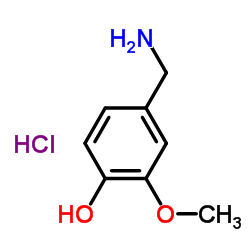 |
香兰素胺盐酸盐
CAS:7149-10-2 |
C8H12ClNO2 |
|
Inhibition by capsaicin and its related vanilloids of compou...
2013-03-14 [Life Sci. 92(6-7) , 368-78, (2013)] |
|
Synthesis of stable isotope-labeled precursors for the biosy...
2011-01-01 [Biosci. Biotechnol. Biochem. 75(8) , 1611-4, (2011)] |
|
Functional loss of pAMT results in biosynthesis of capsinoid...
2009-09-01 [Plant J. 59(6) , 953-61, (2009)] |
|
Valine pathway is more crucial than phenyl propanoid pathway...
2006-09-06 [J. Agric. Food Chem. 54(18) , 6660-6, (2006)] |
|
Functional validation of Capsicum frutescens aminotransferas...
2012-10-01 [Plant Sci. 195 , 96-105, (2012)] |