Structural changes of nucleosomal particles and isolated core-histone octamers induced by chemical modification of lysine residues.
M A Nieto, E Palacián
文献索引:Biochemistry 27(15) , 5635-40, (1988)
全文:HTML全文
摘要
Treatment of nucleosomal particles and isolated core-histone octamers with dimethylmaleic anhydride, but not with acetic anhydride, is accompanied by a biphasic release of the two H2A.H2B dimers, the first dimer being more easily released than the second. With both kinds of particles, 50% of histones H2A and H2B are released for modification of approximately 35% of the histone amino groups. The similar behavior of nucleosomal particles and isolated core-histone octamers is consistent with the same structure of the histone octamer in the nucleosomal particle and in the free octamer in 2 M NaCl. The described release of H2A.H2B dimers allows the preparation of nucleosomal particles deficient in one H2A.H2B dimer and of the histone hexamers H2A.H2B.(H3.H4)2. For more extensive modifications, both reagents, acetic and dimethylmaleic anhydrides, cause the dissociation of nucleosomal particles with liberation of double-stranded DNA, which suggests that lysine amino groups are involved in the binding of histones to DNA. The modified nucleosomal particles are more sensitive to ionic strength than those untreated, and the presence of salt (NaCl) increases the extent of DNA release. The histones corresponding to the liberated DNA, except H2A and H2B released with dimethylmaleic anhydride, are apparently bound to the DNA-containing particles as extra histones.
相关化合物
| 结构式 | 名称/CAS号 | 分子式 | 全部文献 |
|---|---|---|---|
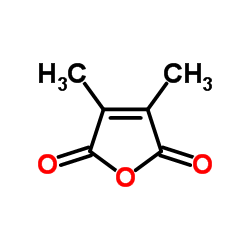 |
二甲基马来酸酐
CAS:766-39-2 |
C6H6O3 |
|
Surface charge switching nanoparticles for magnetic resonanc...
2014-08-25 [Int. J. Pharm. 471(1-2) , 127-34, (2014)] |
|
Multimeric grain-marked micelles for highly efficient photod...
2014-08-25 [Int. J. Pharm. 471(1-2) , 166-72, (2014)] |
|
A smart polymeric platform for multistage nucleus-targeted a...
2015-10-01 [Biomaterials 65 , 43-55, (2015)] |
|
DMAA as a dietary supplement ingredient.
2012-07-09 [Arch. Intern. Med. 172(13) , 1038-9, (2012)] |
|
Only multimeric hensin located in the extracellular matrix c...
1999-06-18 [J. Biol. Chem. 274(25) , 17671-6, (1999)] |