Clinical efficacy of a chlorous acid preoperative skin antiseptic.
R Aly, C Bayles, D J Bibel, H I Maibach, C A Orsine
文献索引:Am. J. Infect. Control 26(4) , 406-12, (1998)
全文:HTML全文
摘要
Among the ways to reduce the incidence of iatrogenic infectious disease is the use of efficacious preoperative antiseptics. Iodophors and chlorhexidines, the chief presurgical disinfectants today, have various problems with practicality. A new preoperative skin antiseptic has been developed (Alcide Corporation, Redmond, Wash) that involves the mixture of a 0.1% sodium chlorite formulation and an activating preparation of 0.5% mandelic acid to produce chlorous acid and other antimicrobial degradation products.Under clinical conditions, the antimicrobial effectiveness of this blended preparation was compared with a chlorhexidine gluconate scrub solution. Using a Latin-square randomization scheme, we treated 2 contralateral abdominal sites and 2 contralateral inguinal sites of healthy male and female volunteers with these antiseptics or the controls of vehicle or activator alone. Microorganisms were harvested and quantified by a standard cylinder-scrub technique.Of 85 volunteers (170 possible sites per test region) screened to meet the USA Food and Drug Administration baseline criteria on population densities of normal flora, 61 abnormal sites and 107 inguinal sites provided suitable data. Against chlorhexidine, the chlorous acid presurgical skin preparation produced superior but statistically equivalent reductions (P > .05) of each volunteer's normal flora at 10 minutes, 30 minutes, and 6 hours after treatment. As many as 4 log reductions were achieved, and activity persisted as long as 6 hours. Compared with chlorhexidine, the chlorous acid product has the practical advantages of a shorter scrub time, less foam, air drying (instead of wiping), and no perceivable residue.An activated chlorous acid product statistically matched the performance of chlorhexidine gluconate in reducing populations of resident flora on treated skin sites. With an easier and shorter application procedure and strong, long-term antimicrobial activity, the new halogenated antiseptic seems to be a useful and possible efficacious preoperative skin disinfectant.
相关化合物
| 结构式 | 名称/CAS号 | 分子式 | 全部文献 |
|---|---|---|---|
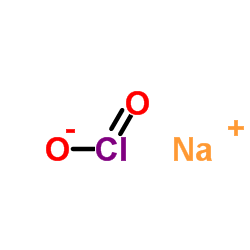 |
亚氯酸钠
CAS:7758-19-2 |
ClNaO2 |
|
Chemical isolation and characterization of different cellulo...
2015-12-10 [Carbohydr. Polym. 134 , 581-9, (2015)] |
|
The influence of lignin on steam pretreatment and mechanical...
2016-01-01 [Bioresour. Technol. 199 , 135-41, (2015)] |
|
Fabricating electrospun cellulose nanofibre adsorbents for i...
2015-01-09 [J. Chromatogr. A. 1376 , 74-83, (2015)] |
|
Ionic liquid-mediated technology to produce cellulose nanocr...
2015-12-10 [Carbohydr. Polym. 134 , 609-16, (2015)] |
|
A comparative study on properties of micro and nanopapers pr...
2015-03-15 [Carbohydr. Polym. 118 , 1-8, (2014)] |