Threshold dose of liver tumor promoting effect of β-naphthoflavone in rats.
Hitomi Hayashi, Eriko Taniai, Reiko Morita, Atsunori Yafune, Kazuhiko Suzuki, Makoto Shibutani, Kunitoshi Mitsumori
文献索引:J. Toxicol. Sci. 37(3) , 517-26, (2012)
全文:HTML全文
摘要
To determine the threshold dose of β-Naphthoflavone (BNF) that induces hepatocellular tumor promoting effects, reactive oxygen species (ROS) generation and thiobarbituric acid-reactive substance (TBARS) formation, and drug-metabolizing enzymes that protect against ROS generation, two-stage liver carcinogenesis model was used. Partial hepatectomized rats (n = 11 to 12) were fed diets containing 0, 0.03, 0.06, 0.125 or 0.25% BNF for 6 weeks after an intraperitoneal injection of N-diethylnitrosamine (DEN) to initiate hepatocarcinogenesis. Histopathologically, glutathione S-transferase placental form (GST-P)-positive foci significantly increased in rats given 0.25% BNF. No marked changes in ROS production and TBARS contents were observed between the BNF treated and DEN alone groups. Real-time RT-PCR showed that the expression of Cyp1a1, Cyp1a2, Cyp1b1 and Nqo1 significantly increased in the groups given 0.03% BNF or more, but Ugt1a6, Akr7a3 and Gstm1 significantly increased in the groups given 0.125% BNF or more. Gpx2 and Yc2 significantly increased in the groups given 0.06% BNF or more and 0.25% BNF, respectively. Inflammation-related genes such as Ccl2, Mmp12, Serpine1 and Cox-2 significantly increased in the 0.25% BNF group. In immunohistochemistry, the number of cyclooxygenase-2 (COX-2)-positive cells increased in rats given 0.25% BNF. These results suggest that 0.25% BNF is the threshold dose for liver tumor promotion, and the fact that inflammation-related genes and COX-2 protein increased in the 0.25% BNF group strongly suggests that inflammation is involved in the liver tumor promoting effect of BNF in rats.
相关化合物
| 结构式 | 名称/CAS号 | 分子式 | 全部文献 |
|---|---|---|---|
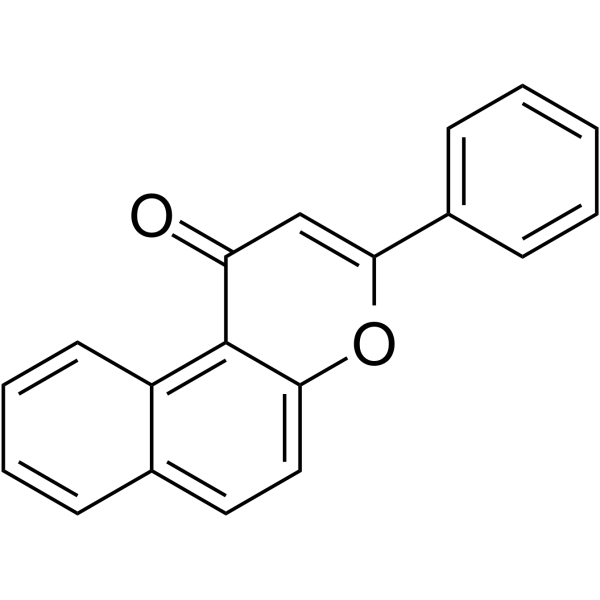 |
β-萘黄酮
CAS:6051-87-2 |
C19H12O2 |
|
Physiological response of alligator gar juveniles (Atractost...
2015-08-01 [Fish Physiol. Biochem. 41 , 1015-27, (2015)] |
|
Snai1 regulates cell lineage allocation and stem cell mainte...
2015-05-12 [EMBO J. 34 , 1319-35, (2015)] |
|
Direct surface visualization of biofilms with high spin coor...
2016-02-01 [Acta Biomater. 31 , 167-77, (2016)] |
|
Improved assays for xenosensor activation based on reverse t...
2015-10-01 [Toxicol. In Vitro 29 , 1759-65, (2015)] |
|
Rapid and sensitive assessment of human hepatocyte functions...
2014-01-01 [Cell. Transplant. 23(12) , 1545-56, (2015)] |