Amoebicidal activities of alexidine against 3 pathogenic strains of acanthamoeba.
Hassan Alizadeh, Sudha Neelam, H Dwight Cavanagh
文献索引:Eye Contact Lens 35(1) , 1-5, (2009)
全文:HTML全文
摘要
Effective pharmacotherapy for Acanthamoeba keratitis has been hampered because of the marked resistance of various stains to a variety of antimicrobial agents. In view of the fact that topical Brolene (propamidine isethionate) and neosporin are currently considered to be the first-line medical treatment of choice in Europe, we sought to determine whether Alexidine is equally effective, because the latter drug is more readily available in the United States.Trophozoites and cysts from 3 pathogenic corneal isolates (A. castellanii, A. polyphaga, and A. rhysodes) were incubated in peptone-yeast extract-glucose medium containing different concentrations of Alexidine for 24 hr. The number of trophozoites was counted by hemocytometer. The cysts were plated in to nonnutrient agar plates precoated with Escherichia coli and observed for viability or excystment over a period of 2 weeks. The capacity of different concentrations of Alexidine to induce cytolysis of corneal epithelial cells was tested in vitro. Chinese hamster corneas were treated with 5 microL of Alexidine topically, every hour; 6 times a day and the corneas were stained with fluorescein to asses the epithelial defects in vivo.Alexidine was effective in killing the trophozoites at a concentration of 10 microg/mL. However, a higher concentration of Alexidine (100 microg/mL) is required to kill Acanthamoeba cysts and the cytotoxic activities of Alexidine are comparable with chlorhexidine. We have also demonstrated that both Alexidine and chlorhexidine at 100 microg/mL induced significant cytopathic effect on the corneal epithelial cells in vitro. In vivo results indicate that Alexidine at a concentration of 100 microg/mL is less toxic than chlorhexidine when applied topically to the Chinese hamster cornea.Our study has identified Alexidine as a novel anti-Acanthamoeba drug and suggests that Alexidine may be an effective therapeutic option because of its potency and low toxicity to the corneal tissues when applied topically in vivo.
相关化合物
| 结构式 | 名称/CAS号 | 分子式 | 全部文献 |
|---|---|---|---|
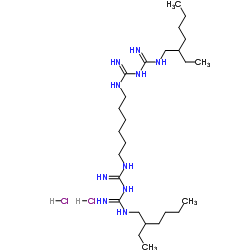 |
Alexidine dihydrochloride
CAS:1715-30-6 |
C26H58Cl2N10 |
|
Chemical interaction of alexidine and sodium hypochlorite.
2012-01-01 [J. Endod. 38(1) , 112-6, (2012)] |
|
Quantitative high throughput screening using a primary human...
2015-01-01 [Nat. Commun. 6 , 6220, (2015)] |
|
Pan-antimicrobial failure of alexidine as a contact lens dis...
2012-07-01 [Eye Contact Lens 38(4) , 222-6, (2012)] |
|
Mechanism of drug failure in fusarium keratitis, 2004-2006.
2014-01-02 [N. Engl. J. Med. 370(1) , 88-9, (2014)] |
|
Alexidine and chlorhexidine bind to lipopolysaccharide and l...
2008-10-01 [J. Antimicrob. Chemother. 62(4) , 730-7, (2008)] |