Organ-targeted mutagenicity of nitrofurantoin in Big Blue transgenic mice.
Philippe Quillardet, Xavier Arrault, Valérie Michel, Eliette Touati
文献索引:Mutagenesis 21(5) , 305-11, (2006)
全文:HTML全文
摘要
Nitrofurans are widely used in human medicine, as nitrofurantoin and nifuroxazide, still prescribed for long-term antimicrobial prophylaxis of urinary tract and gastrointestinal infection in humans respectively. Recent experiments in mammals, as well as reports mentioning toxic effects in humans associated with a long-term use, specially in the case of nitrofurantoin, raised the need for reevaluating their genotoxicity. The objective of this study was to determine whether these two compounds induce a mutagenic effect in the Big Blue transgenic mouse mutation assay. Mice were orally treated either with nitrofurantoin or nifuroxazide for five consecutive days and sacrificed 3 weeks later. In order to optimize the genotoxic response, the doses used for each compound were 25-fold higher as the posology in humans. They corresponded to 50% of the highest doses tolerated by mice. The mutant frequency was determined from kidney, lung, bladder, caecum, colon, small intestine, spleen and stomach. A weak mutagenic response of nitrofurantoin-treated mice specifically in the kidney was observed. As in the case of other nitrofuran compounds, the mutation spectra determined from treated samples exhibited slightly more GC-->TA transversions as compared with untreated conditions. These data are relevant to the targeted action of nitrofurantoin as a urinary antimicrobial agent. No significant increase of mutants was detected in the case of nifuroxazide-treated mice whatever the organs analysed.
相关化合物
| 结构式 | 名称/CAS号 | 分子式 | 全部文献 |
|---|---|---|---|
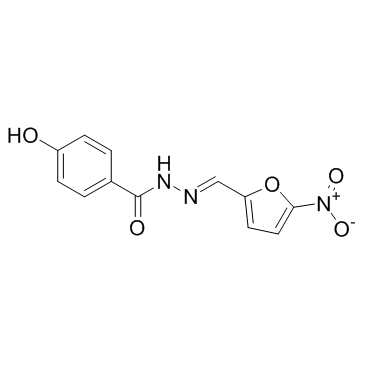 |
硝呋酚酰肼
CAS:965-52-6 |
C12H9N3O5 |
|
Determination of nitrofuran and chloramphenicol residues by ...
2015-03-03 [Anal. Chim. Acta 862 , 41-52, (2015)] |
|
The transcriptional modulator BCL6 as a molecular target for...
2015-02-26 [Oncogene 34(9) , 1073-82, (2015)] |
|
Genotoxicity of 2-nitro-7-methoxy-naphtho[2,1-b]furan (R7000...
2002-09-01 [Res. Microbiol. 153(7) , 427-34, (2002)] |
|
Determination of nitrofurans in animal feeds by liquid chrom...
2007-03-14 [Anal. Chim. Acta 586(1-2) , 359-65, (2007)] |
|
Fly agaric (Amanita muscaria) poisoning, case report and rev...
2005-06-01 [Toxicon 45(7) , 941-3, (2005)] |