Effect of ginger on acute and delayed chemotherapy-induced nausea and vomiting: a pilot, randomized, open-label clinical trial.
Yunes Panahi, Alireza Saadat, Amirhossein Sahebkar, Farshad Hashemian, Mojgan Taghikhani, Ehsan Abolhasani
文献索引:Integr. Cancer Ther. 11(3) , 204-11, (2012)
全文:HTML全文
摘要
Nausea and vomiting are among the most prevalent and disturbing side effects of chemotherapy. Therefore, there is a need for additional antiemetic agents that could effectively reduce chemotherapy-induced nausea and vomiting (CINV), whether alone or in combination with current standard therapies. Since clinical data on the effectiveness of ginger in patients with advanced breast cancer is lacking, the present study aimed to evaluate the effects of ginger against both acute and delayed forms of CINV in a population with advanced breast cancer as the main malignancy.In this pilot, randomized, open-label clinical trial, 100 women (mean age = 51.83 ± 9.18 years) with advanced breast cancer who were initially assigned to standard chemotherapy protocol with docetaxel, epirubicin, and cyclophosphamide (the TEC regimen) were randomized to receive ginger (1.5 g/d in 3 divided doses every 8 hours) plus standard antiemetic regimen (granisetron plus dexamethasone; the ginger group) or standard antiemetic regimen alone (control group). The duration of treatment with ginger was specified to 4 days from the initiation of chemotherapy. Prevalence, score, and severity of nausea, vomiting, and retching were assessed using a simplified form of Rhodes index in the first 6 hours, between 6 to 24 hours, and days 2, 3, and 4 postchemotherapy.A significantly lower prevalence of nausea was observed in the ginger group during 6 to 24 hours postchemotherapy. Despite this effect, no other significant additional benefit from ginger (1.5 g/d) was observed against prevalence or severity of nausea, vomiting, and retching in any of the assessed periods.Addition of ginger (1.5 g/d) to standard antiemetic therapy (granisetron plus dexamethasone) in patients with advanced breast cancer effectively reduces the prevalence of nausea 6 to 24 hours postchemotherapy. However, there is no other additional advantage for ginger in reducing prevalence or severity of acute or delayed CINV.
相关化合物
| 结构式 | 名称/CAS号 | 分子式 | 全部文献 |
|---|---|---|---|
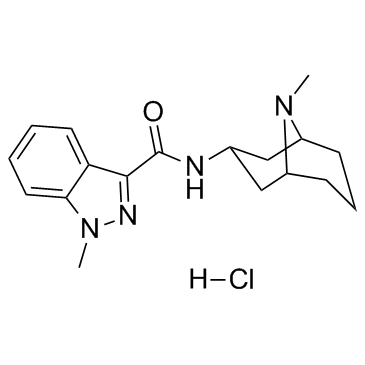 |
盐酸格拉司琼
CAS:107007-99-8 |
C18H25ClN4O |
|
Pronociceptive and Antinociceptive Effects of Buprenorphine ...
2015-07-01 [J. Neurosci. 35 , 9580-94, (2015)] |
|
In vitro percutaneous absorption enhancement of granisetron ...
2013-04-01 [Drug Dev. Ind. Pharm. 39(4) , 561-8, (2013)] |
|
Comparison of the efficacy of ondansetron and granisetron to...
2013-02-01 [Surg. Laparosc. Endosc. Percutan. Tech. 23(1) , 79-87, (2013)] |
|
Retraction record rocks community.
2012-09-20 [Nature 489(7416) , 346-7, (2012)] |
|
A meta-analysis of prevention of postoperative nausea and vo...
2012-10-01 [Anaesthesia 67(10) , 1076-90, (2012)] |