Effectiveness of palonosetron for preventing delayed chemotherapy-induced nausea and vomiting following moderately emetogenic chemotherapy in patients with gastrointestinal cancer.
Michiyasu Murakami, Hiroki Hashimoto, Kyohei Yamaguchi, Ikuko Yamaguchi, Shozo Senba, Takeshi Siraishi
文献索引:Support Care Cancer 22(4) , 905-9, (2014)
全文:HTML全文
摘要
Patients with gastrointestinal cancer who were receiving moderately emetogenic chemotherapy (MEC) were switched from granisetron, a first-generation 5-hydroxytryptamine-3 receptor antagonist, to palonosetron at our hospital. In the present study, we compared effectiveness before and after switching antiemetic treatment.Among patients who were receiving MEC for gastrointestinal cancer, we prospectively observed 46 patients given granisetron and 46 given palonosetron. To allow adverse reactions to be graded in accordance with the Common Terminology Criteria for Adverse Events, version 4.0, a questionnaire designed at our hospital was used to compare the occurrence of delayed nausea and vomiting between patients who received granisetron (GRA group) and those who received palonosetron (PAL group).The incidence of delayed nausea was significantly lower in the PAL group (8.7%, 4/46; p < 0.01) than in the GRA group (37%, 17/46). Delayed vomiting developed in five patients (10.9%) in the GRA group, but did not occur in the PAL group. On the basis of the results of multivariate analysis, young age, female gender, and the use of granisetron were significant risk factors for delayed nausea.Our survey showed that palonosetron effectively controls delayed nausea caused by MEC for gastrointestinal cancer.
相关化合物
| 结构式 | 名称/CAS号 | 分子式 | 全部文献 |
|---|---|---|---|
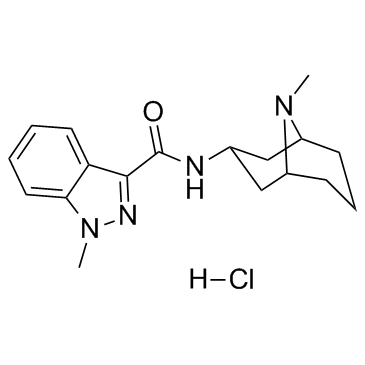 |
盐酸格拉司琼
CAS:107007-99-8 |
C18H25ClN4O |
|
Pronociceptive and Antinociceptive Effects of Buprenorphine ...
2015-07-01 [J. Neurosci. 35 , 9580-94, (2015)] |
|
In vitro percutaneous absorption enhancement of granisetron ...
2013-04-01 [Drug Dev. Ind. Pharm. 39(4) , 561-8, (2013)] |
|
Comparison of the efficacy of ondansetron and granisetron to...
2013-02-01 [Surg. Laparosc. Endosc. Percutan. Tech. 23(1) , 79-87, (2013)] |
|
Retraction record rocks community.
2012-09-20 [Nature 489(7416) , 346-7, (2012)] |
|
A meta-analysis of prevention of postoperative nausea and vo...
2012-10-01 [Anaesthesia 67(10) , 1076-90, (2012)] |