Aqueous p-chloronitrobenzene decomposition induced by contact glow discharge electrolysis.
Yongjun Liu
文献索引:J. Hazard. Mater. 166(2-3) , 1495-9, (2009)
全文:HTML全文
摘要
Aqueous p-chloronitrobenzene (PCNB) decomposition induced by contact glow discharge electrolysis under various reaction conditions was investigated. Experimental results showed that, at voltage 450-550 V and initial concentration 50-500 mg/L, the decay of PCNB can be described by a first-order reaction kinetics of In(C(0)/C(t))=0.029 (I/V)t, where C(0), I, V and C(t) denote the initial PCNB concentration (mg/L), applied current (A), solution volume (L) and instantaneous PCNB concentration (mg/L) at treatment time t (min). Major intermediate products such as 4-nitrophenol, 2-chloro-5-nitrophenol, oxalic and formic acids, chloride and nitrate ions were identified by LC/MS and IC, respectively. No chlorophenols present indicated that the dechlorination was easier than denitration from the aromatic ring of PCNB. Formation of hydrogen peroxide during the degradation was observed and the role of Fenton's reaction was examined. Hydroxyl radicals may be the most responsible species for PCNB degradation.
相关化合物
| 结构式 | 名称/CAS号 | 分子式 | 全部文献 |
|---|---|---|---|
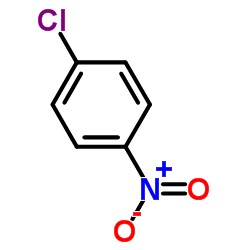 |
对硝基氯苯
CAS:100-00-5 |
C6H4ClNO2 |
|
Optimizations of packed sorbent and inlet temperature for la...
2014-08-22 [J. Chromatogr. A. 1356 , 221-9, (2014)] |
|
Precursor chemistry matters in boosting photoredox activity ...
2015-11-21 [Nanoscale 7 , 18062-70, (2015)] |
|
Degradation p-chloronitrobenzene in ozone-loaded system with...
2011-09-01 [Bull. Environ. Contam. Toxicol. 87(3) , 297-302, (2011)] |
|
Substituent effect on electronic structures of halonitrobenz...
2008-12-15 [Spectrochim. Acta. A. Mol. Biomol. Spectrosc. 71(4) , 1499-502, (2008)] |
|
Dechlorination/detoxification of aromatic chlorides using fl...
2009-12-01 [Waste Manag. 29(12) , 3004-8, (2009)] |