Urinary excretion of toluene diisocyanates in rats following dermal exposure.
Hui-Jung Yeh, Wei-Chao Lin, Tung-Sheng Shih, Perng-Jy Tsai, Shan-Tair Wang, Ho-Yuan Chang
文献索引:J. Appl. Toxicol. 28(2) , 189-95, (2008)
全文:HTML全文
摘要
Toluene diisocyanates (TDI) are commonly used in polyurethane (PU)-related products. TDIs have been documented as the leading cause of occupational asthma. Skin exposure to TDI in the workplace is common. However, no studies in the literature have investigated the exact biomarker concentration profile for skin TDI absorption through any in vivo animal studies. In this study a rat model was used to evaluate the TDI skin absorption to explore the dose-response pattern and to determine the kinetic characteristics of urinary toluene diamine (U-TDA) during skin exposure. TDIs were topically exposed on the dorsum of rat skin at 0.2%, 1% and 5%. Consecutive urine samples were collected for 6 days and U-TDA were analysed using GC/ECD. It was demonstrated in this rat study that absorption of 2,4- and 2,6-TDI through skin contact is possible. A clear dose-dependent skin absorption relationship for 2,4- and 2,6-TDI was demonstrated by the AUC, Cmax findings and accumulative amounts (r > or = 0.968). U-TDA concentration profiles in 6-day consecutive urine samples fit well in the first-order kinetics, although higher order kinetics could not be excluded for the high dose. The apparent half-lives for excretory urinary TDA were about 20 h consistent at various skin exposures. It is concluded that skin absorption of TDI was confirmed in a rat model and a clear dose-dependent skin absorption relationship for 2,4- and 2,6-TDI was demonstrated. Excretory U-TDA concentrations in 6-day consecutive urine samples via skin exposure reveal the first-order kinetics and the half-lives were about 20 h.
相关化合物
| 结构式 | 名称/CAS号 | 分子式 | 全部文献 |
|---|---|---|---|
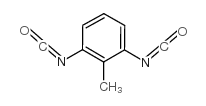 |
甲苯2,6-二异氰酸酯
CAS:91-08-7 |
C9H6N2O2 |
|
Biological monitoring as a valid tool to assess occupational...
2012-01-01 [Med. Lav. 103(5) , 361-71, (2012)] |
|
Magnetic field dependent electro-conductivity of the graphit...
2015-09-14 [Soft Matter 11 , 6893-902, (2015)] |
|
LC-MS determination of urinary toluenediamine in workers exp...
2002-08-05 [Toxicol. Lett. 134(1-3) , 259-64, (2002)] |
|
The GSTP1 Ile105 Val polymorphism modifies the metabolism of...
2010-02-01 [Pharmacogenet. Genomics 20(2) , 104-11, (2010)] |
|
Determination of unreacted 2,4-toluene diisocyanate (2,4TDI)...
2003-12-01 [Analyst 128(12) , 1447-51, (2003)] |