An asthma model developed in the guinea pig by intranasal application of 2,4-toluene diisocyanate.
Y Sugawara, Y Okamoto, T Sawahata, K Tanaka
文献索引:Int. Arch. Allergy Immunol. 101(1) , 95-101, (1993)
全文:HTML全文
摘要
Guinea pigs were sensitized with 2,4-toluene diisocyanate (TDI) by a repetitive application onto the bilateral nasal vestibules once a day for 5 consecutive days. When these animals were further treated with TDI for additional 9 weeks, a number of these animals exhibited external symptoms similar to those in human asthmatics, such as labored breathing characterized by prolonged expiration phases. Pathological examination of the lung of these animals clearly revealed contraction of bronchioles where hypertrophy of the smooth muscle and hypersecretion of mucin were evident. Furthermore, infiltration of numerous inflammatory cells, especially eosinophils, was observed in the peribronchial area. In these animals, the histamine-releasing activity of lung tissues was also demonstrated after challenge with TDI-guinea pig serum albumin conjugate. The histamine-releasing activity was found to be elevated to a maximum level during the first 2 weeks after sensitization and to remain at a constant level throughout the rest of the treatment period. Similar time courses were observed with respect to serum levels of TDI-specific antibodies, IgE and IgG. A survey of a series of 28 separate experiments using totally 565 animals indicated that the incidence of animals exhibiting an asthmatic response was 35% on average, ranging from 0 to 58.3%. Furthermore, the serum level of TDI-specific IgG, rather than that of TDI-specific IgE, was rather closely related to the incidence of asthmatic responses in TDI-treated guinea pigs.
相关化合物
| 结构式 | 名称/CAS号 | 分子式 | 全部文献 |
|---|---|---|---|
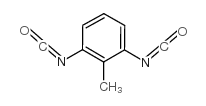 |
甲苯2,6-二异氰酸酯
CAS:91-08-7 |
C9H6N2O2 |
|
Biological monitoring as a valid tool to assess occupational...
2012-01-01 [Med. Lav. 103(5) , 361-71, (2012)] |
|
Magnetic field dependent electro-conductivity of the graphit...
2015-09-14 [Soft Matter 11 , 6893-902, (2015)] |
|
LC-MS determination of urinary toluenediamine in workers exp...
2002-08-05 [Toxicol. Lett. 134(1-3) , 259-64, (2002)] |
|
The GSTP1 Ile105 Val polymorphism modifies the metabolism of...
2010-02-01 [Pharmacogenet. Genomics 20(2) , 104-11, (2010)] |
|
Determination of unreacted 2,4-toluene diisocyanate (2,4TDI)...
2003-12-01 [Analyst 128(12) , 1447-51, (2003)] |