Influence of calcium channel antagonists on nonsomatic signs of nicotine and D-amphetamine withdrawal in mice.
Grażyna Biała, Piotr Polak, Agnieszka Michalak, Marta Kruk-Słomka, Barbara Budzyńska
文献索引:Pharmacol. Rep. 66(2) , 212-22, (2014)
全文:HTML全文
摘要
Nonsomatic signs of psychostimulant withdrawal, difficult to demonstrate in animal paradigms, may appear to promote drug seeking and drug relapse in humans; thus, it is important to understand the mechanisms that mediate this kind of behaviors. The present study was undertaken to examine the calcium-dependent mechanism of negative nonsomatic and anhedonia-related symptoms of acute and protracted withdrawal of nicotine and D-amphetamine.Mice were chronically treated with nicotine (seven days, three times daily, 3.35 mg/kg, sc) or D-amphetamine (14 days, once daily, 2.5mg/kg, ip). Then, at the first, seventh or 14th day of withdrawal, anxiety- or depression-related effects, as well as cognition or nociception were studied.Our results demonstrated that, at the seventh or 14th day of D-amphetamine or nicotine withdrawal, respectively, mice exhibited increased anxiety and depression-like effects, memory impairment and hyperalgesia. Further, major findings showed that calcium channel antagonists, i.e., nimodipine, verapamil and flunarizine (10 and 20mg/kg, ip), injected before the test, attenuated above-mentioned signs of drug withdrawal.As an outcome, these findings support the hypothesis that similar calcium-dependent mechanisms are involved in an aversive nonsomatic component, associated with nicotine or d-amphetamine withdrawal. We can suggest that calcium channel blockers have potential to alleviate drug withdrawal and may thus be beneficial as pharmacotherapy of drug cessation and relapse.Copyright © 2014 Institute of Pharmacology, Polish Academy of Sciences. Published by Elsevier Urban & Partner Sp. z o.o. All rights reserved.
相关化合物
| 结构式 | 名称/CAS号 | 分子式 | 全部文献 |
|---|---|---|---|
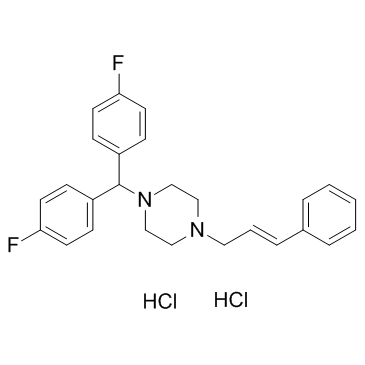 |
盐酸氟桂利嗪
CAS:30484-77-6 |
C26H28Cl2F2N2 |
|
Propofol-induced pain sensation involves multiple mechanisms...
2015-09-01 [Pflugers Arch. 467 , 2011-20, (2015)] |
|
An in vivo antilymphatic screen in zebrafish identifies nove...
2014-10-01 [Mol. Cancer Ther. 13(10) , 2450-62, (2014)] |
|
A high throughput screen identifies chemical modulators of t...
2011-01-01 [PLoS ONE 6(3) , e17559, (2011)] |
|
Calcium antagonists as an add-on therapy for drug-resistant ...
2013-01-01 [Cochrane Database Syst. Rev. 3 , CD002750, (2013)] |
|
In a nongenomic action, steroid hormone 20-hydroxyecdysone i...
2014-05-01 [Endocrinology 155(5) , 1738-50, (2014)] |