Involvement of reactive persulfides in biological bismethylmercury sulfide formation.
Yumi Abiko, Eiko Yoshida, Isao Ishii, Jon M Fukuto, Takaaki Akaike, Yoshito Kumagai
文献索引:Chem. Res. Toxicol. 28 , 1301-6, (2015)
全文:HTML全文
摘要
Bismethylmercury sulfide (MeHg)2S has been found to be a detoxified metabolite of methylmercury (MeHg) that is produced by SH-SY5Y cells and in livers of rats exposed to MeHg. (MeHg)2S could be formed through the interactions between MeHg and sulfur species such as hydrogen sulfide (H2S or HS(-)), but the origin of its sulfur has not been fully identified. We herein examined the formation of (MeHg)2S through interactions between MeHg and persulfides, polysulfides, and protein preparations. Investigations using HPLC/atomic absorption spectrophotometry and EI-MS revealed that NaHS and Na2S4 react readily with MeHg to give (MeHg)2S, and similar results were found using GSH persulfide (GSSH) formed endogenously or generated enzymatically in vitro. (MeHg)2S was also formed by incubation of MeHg with liver and heart cytosolic fractions prepared from wild-type mice but not with those from mice lacking cystathionine γ-lyase (CSE) that catalyzes the formation of cysteine persulfide. Consistent with this, (MeHg)2S was detected in a variety of tissues taken from wild-type mice intraperitoneally injected with MeHg in vivo but not in those from MeHg-injected CSE knockout mice. By separating liver fractions by column chromatography, we found numerous proteins that contain persulfides: one of the proteins was identified as being glutathione S-transferase pi 1. These results indicate that the formation of (MeHg)2S can be attributed to interactions between MeHg and endogenous free persulfide species, as well as protein-bound cysteine persulfide.
相关化合物
| 结构式 | 名称/CAS号 | 分子式 | 全部文献 |
|---|---|---|---|
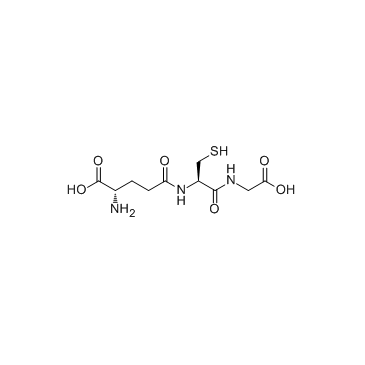 |
谷胱甘肽/5-L-谷氨酰-L-半胱氨酰甘氨酸
CAS:70-18-8 |
C10H17N3O6S |
|
Assembly and structure of Lys33-linked polyubiquitin reveals...
2015-04-15 [Biochem. J. 467(2) , 345-52, (2015)] |
|
A survey of the interactome of Kaposi's sarcoma-associated h...
2015-05-01 [J. Virol. 89(9) , 4918-31, (2015)] |
|
Phospho-tyrosine dependent protein-protein interaction netwo...
2015-03-01 [Mol. Syst. Biol. 11(3) , 794, (2015)] |
|
High fat, high sucrose diet causes cardiac mitochondrial dys...
2015-01-01 [J. Mol. Cell. Cardiol. 78 , 165-73, (2014)] |
|
Disturbed Hsp70 and Hsp27 expression and thiol redox status ...
2014-09-01 [Food Chem. Toxicol. 71 , 97-105, (2014)] |