Pyriproxyfen and house flies (Diptera: Muscidae): effects of direct exposure and autodissemination to larval habitats.
Christopher J Geden, Gregor J Devine
文献索引:J. Med. Entomol. 49(3) , 606-13, (2012)
全文:HTML全文
摘要
Pyriproxyfen is an insect growth regulator with juvenile hormone-like activity that has potential uses for dipterans that are difficult to manage with conventional insecticides, such as house flies (Musca domestica L.). The objectives of this study were to determine the efficacy of this insect growth regulator against house flies using variety of delivery systems and target life stages, including an evaluation of the potential for autodissemination by female flies to larval development sites. Adult female house flies exposed to filter paper (3.75% active ingredient) or sugar treated with pyriproxyfen (0.01-0.1%) produced significantly fewer F1 pupae than untreated flies. Adult emergence from pupae was unaffected. In contrast, treatment of larval rearing medium with 0.35 ml/cm2 of a 12 mg pyriproxyfen/liter preparation had no effect on the number of pupae developing from eggs but markedly inhibited adult emergence from those pupae. There was little difference in susceptibility between an insecticide-susceptible and a wild strain of house fly. The LC50 for inhibiting fly emergence of dust formulations in diatomaceous earth incorporating commercial pyriproxyfen products ranged from 8 to 26 mg/liter, with little difference among products. Compared with untreated flies, significantly fewer pupae were produced at concentrations > 0.5% and no adults were produced at concentrations > 0.05% pyriproxyfen. When gravid females were exposed for 1 h to treated fabric (6 mg pyriproxyfen/cm2) and allowed to oviposit in rearing media containing eggs, sufficient pyriproxyfen was autodisseminated to reduce adult emergence from those eggs by > 99%. Intermittent contact with treated fabric over 2 d reduced adult emergence by 63-76%.
相关化合物
| 结构式 | 名称/CAS号 | 分子式 | 全部文献 |
|---|---|---|---|
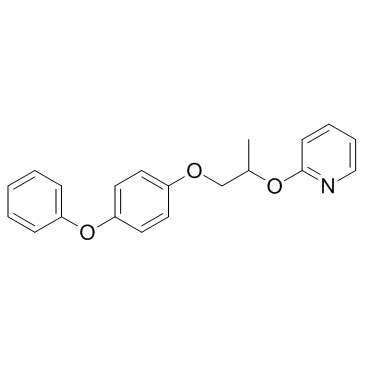 |
吡丙醚
CAS:95737-68-1 |
C20H19NO3 |
|
The efficacy of a combined larvicide-adulticide in ultralow ...
2013-03-01 [Parasitol. Res. 112(3) , 1237-46, (2013)] |
|
Inheritance mode, cross-resistance and realized heritability...
2015-02-01 [Acta Trop. 142 , 149-55, (2014)] |
|
Attractive toxic sugar baits mixed with pyriproxyfen sprayed...
2014-07-01 [J. Med. Entomol. 51(4) , 896-9, (2014)] |
|
Ultra-high performance liquid chromatography-quadrupole time...
2014-06-06 [J. Chromatogr. A. 1345 , 86-97, (2014)] |
|
Effects of pyriproxyfen and buprofezin on immature developme...
2012-12-01 [Med. Vet. Entomol. 26(4) , 379-85, (2012)] |