Assessment of the ability of 4CMB and 4HMB to induce primary genetic damage in strains of Escherichia coli.
K May, DC Lodge, J Bootman
文献索引:Mutat. Res. 100(1-4) , 9-13, (1982)
全文:HTML全文
摘要
Studies were undertaken to investigate the ability of 4CMB and 4HMB to induce primary DNA damage in bacteria as shown by differential lethality in strains of E. coli proficient and deficient in DNA repair. It has been demonstrated in these laboratories that the assay system used will detect weak DNA-damaging agents by the use of a prolonged incubation period and, where appropriate, the inclusion of an S9 mix activating system. Both 4CMB and 4HMB induced primary DNA damage in E. coli, giving similar responses in the presence and absence of S9 mix. A comparison based on the response at the lowest inclusion level (250 microgram/ml) indicates that 4CMB was more active. 4CMB also caused greater lethality in a uvrA-, recA-, lexA- strain than in the other repair-deficient (uvrA-, polA-) strain employed. 4HMB was approximately equitoxic to both repair-deficient strains. It is suggested that this difference may be explained it both chemicals cause DNA lesions recognized by the uvrA system, and 4CMB causes additional lesions recognised or repaired by the recA or lexA systems.
相关化合物
| 结构式 | 名称/CAS号 | 分子式 | 全部文献 |
|---|---|---|---|
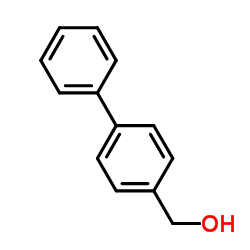 |
4-联苯甲醇
CAS:3597-91-9 |
C13H12O |
|
UKEMS trial compounds: induction of unscheduled DNA synthesi...
1982-01-01 [Mutat. Res. 100(1-4) , 207-9, (1982)] |
|
An assay for mutagenic activity of 4CMB, 4HMB and BC, using ...
1982-01-01 [Mutat. Res. 100(1-4) , 81-5, (1982)] |
|
Mutation at the TK locus of mouse lymphoma L5178Y cells by 4...
1982-01-01 [Mutat. Res. 100(1-4) , 249-51, (1982)] |
|
The cytotoxic and mutagenic effects of 4CMB, BC and 4HMB in ...
1982-01-01 [Mutat. Res. 100(1-4) , 239-44, (1982)] |
|
A comparison of the response of BHK21 C13 cells to 4-chlorom...
1982-01-01 [Mutat. Res. 100(1-4) , 223-6, (1982)] |