Binding of polychlorinated biphenyls/metabolites to hemoglobin.
Nilufer Tampal, Steven Myers, Larry W Robertson
文献索引:Toxicol. Lett. 142(1-2) , 53-60, (2003)
全文:HTML全文
摘要
Polychlorinated biphenyls (PCBs) may form reactive electrophiles that can bind covalently to hemoglobin in vivo. Female C57/BL6 mice, pretreated with phenobarbital and P-naphthoflavone, were injected with either radiolabeled 4-chlorobiphenyl, 3,3',4.4'-tetrachlorobiphenyl, benzo[a]pyrene (B[a]P) or the corresponding non-labeled 4-chlorobiphenyl, 3.3',4.4'-tetrachlorobiphenyl, B[a]P or vehicle. Blood was collected at different time points. At 24 h a greater presence of 4-chlorobiphenyl and 3,3',4.4'-tetrachlorobiphenyl in the plasma, compared with the erythrocytes, was observed. For all three treatment groups the radioactivity in the hemolysate was found to be greater than the vehicle-treated group, except at 2 h after dosing, suggesting an association with hemoglobin. Covalent binding with globin was 10-fold greater for 4-chlorobiphenyl-treated animals compared with 3,3',4,4'-tetrachlorobiphenyl-treated animals. Liquid chromatography-mass spectral analysis of globin was used to identify adducts. Our preliminary data show an increase in mass corresponding to adducts of oxidized metabolites of PCBs. Detection of adducts of PCBs with hemoglobin could provide a valuable tool to evaluate acute exposure of a population.
相关化合物
| 结构式 | 名称/CAS号 | 分子式 | 全部文献 |
|---|---|---|---|
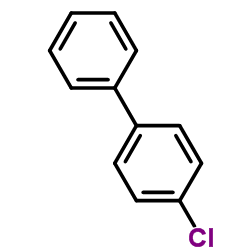 |
4-氯联苯
CAS:2051-62-9 |
C12H9Cl |
|
Computational framework for predictive biodegradation.
2009-12-15 [Biotechnol. Bioeng. 104(6) , 1086-97, (2009)] |
|
Pathways and products of the degradation of PCBs by the sodi...
2007-04-01 [Chemosphere 68(5) , 871-9, (2007)] |
|
Degradation and mineralization of 2-chloro-, 3-chloro- and 4...
2008-01-01 [J. Environ. Sci. (China) 20(10) , 1250-7, (2008)] |
|
Comparison of the actions of 4-chlorobiphenyl and its hydrox...
2005-01-01 [Reprod. Toxicol. 20(1) , 57-64, (2005)] |
|
3-Methylcholanthrene (3-MC) and 4-chlorobiphenyl (PCB3) geno...
2010-11-01 [Environ. Int. 36(8) , 970-9, (2010)] |