Methyl group deficiency and guanidino production in uremia.
Burton D Cohen
文献索引:Mol. Cell Biochem. 244(1-2) , 31-6, (2003)
全文:HTML全文
摘要
Guanidinosuccinic acid (GSA) is one of the earliest uremic toxins isolated and its toxicity identified. Its metabolic origins have remained obscure until recently when a series of studies showed that it arose from the oxidation of argininosuccinic acid (ASA) by free radicals. The stimulus for this oxidation, occurring optimally in the presence of the failed kidney, is the rising level of urea which, through enzyme inhibition, results in a decline in hepatic levels of the semi-essential amino acid, arginine. It is further noted that concentrations of GSA in both serum and urine decline sharply in animals and humans exposed to the essential amino acid, methionine. In this review the argument is advanced that uremics suffer from a defective ability to generate methyl groups due to anorexia, dietary restrictions and renal protein leakage. This leads to the accumulation of homocysteine, a substance known to produce vascular damage. Even in healthy subjects intake of choline together with methionine is insufficient to satisfy total metabolic requirements for methyl groups. In end-stage renal disease, therefore, protein restriction contributes to the build-up of toxins in uremia. Replacement using specific amino acid mixtures should be directed toward identified deficiencies and adequacy monitored by following serum levels of the related toxins, in this case GSA and homocysteine.
相关化合物
| 结构式 | 名称/CAS号 | 分子式 | 全部文献 |
|---|---|---|---|
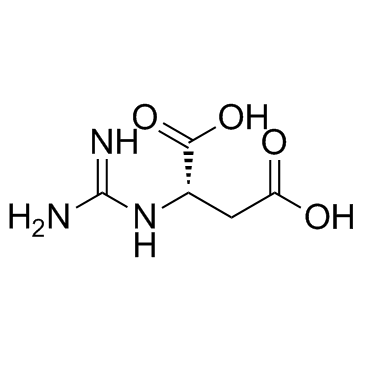 |
2-胍基琥珀酸
CAS:6133-30-8 |
C5H9N3O4 |
|
Uraemic guanidino compounds inhibit gamma-aminobutyric acid-...
1999-04-16 [Neurosci. Lett. 265(2) , 83-6, (1999)] |
|
Effect of NaCN on currents evoked by uremic retention solute...
2004-05-15 [Brain Res. 1008(1) , 107-12, (2004)] |
|
Accumulation of methylguanidine and changes in guanidino com...
2008-06-01 [Metab. Clin. Exp. 57(6) , 802-10, (2008)] |
|
Formation of guanidinosuccinic acid, a stable nitric oxide m...
1999-07-01 [Free Radic. Res. 31(1) , 59-65, (1999)] |
|
First indications demonstrating the preventive effects of NZ...
2009-07-01 [Biol. Pharm. Bull. 32(7) , 1204-8, (2009)] |