Robert A Kanaly, Natsuko Hamamura
文献索引:Chemosphere 92(11) , 1442-9, (2013)
全文:HTML全文
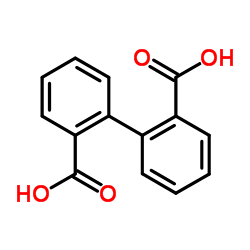
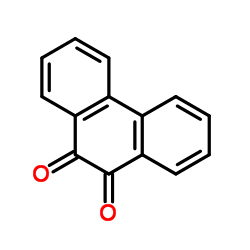
Transformation of 9,10-phenanthrenedione, a cytotoxic derivative of phenanthrene, was shown to occur by a soil bacterium belonging to the genus Sphingobium. Phenanthrene-grown cells of this strain were exposed to 50mgL(-1) 9,10-phenanthrenedione in liquid cultures, extracted, and extracts were analyzed by liquid chromatography electrospray ionization mass spectrometry in negative ionization mode. Full scan analyses of exposed cells over the range from m/z 50 to m/z 500 were compared to abiotic and biotic controls. Product and precursor ion scan mode analyses indicated that at least three aromatic ring-cleavage transformation products of 9,10-phenanthrenedione were present and structures for these products, corresponding to [M-H](-)=271, [M-H](-)=241, and [M-H](-)=339 were proposed to be 4-(1-hydroxy-3,4-dioxo-2-naphthyl)-2-oxo-but-3-enoic acid, 2,2'-diphenic acid and 2-[(6-carboxy-2,3-dihydroxy-phenyl)-hydroxy-methyl]-5-oxo-hex-3-enedioic acid. The identity of 2,2'-diphenic acid was confirmed by comparison to an authentic standard and when the strain was exposed to 50mgL(-1) 2,2'-diphenic acid in separate assays, a transformation product with a similar mass spectrum as 9,10-phenanthrenedione-derived [M-H](-)=339 was revealed. Based upon these results, pathways for the transformation of 9,10-phenanthrenedione by strain KK22 were proposed. Strain KK22 appeared unable to use 9,10-phenanthrenedione as a growth substrate under these conditions. This is the first report of potential biotransformation pathways of 9,10-phenanthrenedione by a bacterium. Copyright © 2013 Elsevier Ltd. All rights reserved.