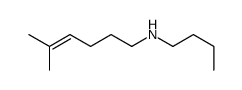
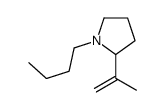
Abstract: N-Lithio-N-butyl-5-methyl-4-hexenamine (1) was employed as a mechanistic probe for electron transfer (ET) reactions with organic oxidants. Oxidation of 1 gave the N-butyl-5- methyl-4-hexenaminyl radical (2) that cyclized to the l-methyl-1-(2-N-butylpyrrolidinyl) ethyl radical (3). Products from radical 2, formed by decomposition of the corresponding tetrazene in the absence of good trapping agents, were determined. Radical 2 was also produced in ...




![N-butyl-N-[[butyl(5-methylhex-4-enyl)amino]diazenyl]-5-methylhex-4-en-1-amine结构式](https://image.chemsrc.com/caspic/426/88015-30-9.png)