One of these, 9-benzyl-2-phenyl-7, 8, 9, 10-tetrahydropyrido [3, 4-e][1, 2, 4] triazolo [1, 5-c] pyrimidin-5 (6H)-one, showed good activity in rats as a potential anxiolytic agent without sedative liability. However, it increased the rotorod deficit produced by ethanol at anxiolytic doses, an indication of alcohol interaction. Thus, none of the compounds showed an advantage over CGS 9896 (Yokoyama et al. J. Med. Chem. 1982, 25,337-339), which is ...
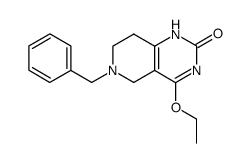
![6-苯甲基-5,6,7,8-四氢-1H-哌啶并[4,3-D]2,4-二嘧啶酮结构式](https://image.chemsrc.com/caspic/289/135481-57-1.png)
![3-[BENZYL-(2-CYANO-ETHYL)-AMINO]-PROPIONITRILE结构式](https://image.chemsrc.com/caspic/092/782-87-6.png)