Separation of Branched Poly(bisphenol A carbonate) Structures by Solvent Gradient at Near-Critical Conditions and Two-Dimensional Liquid Chromatography
Nico Apel, Elena Uliyanchenko, Stephan Moyses, Stijn Rommens, Christian Wold, Tibor Macko, Robert Brüll
文献索引:10.1021/acs.analchem.8b00618
全文:HTML全文
摘要
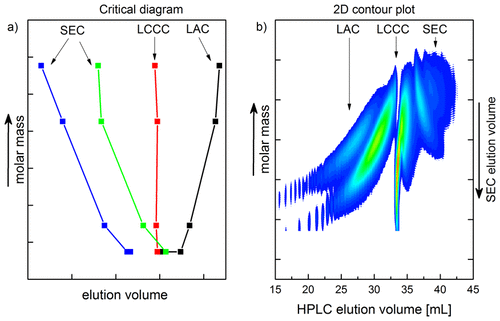
Branching is a molecular metric that strongly influences the application properties of polymers. Consequently, detailed information on the microstructure is required to gain a deeper understanding of structure–property relationships. In the present case, we employ high-performance liquid chromatography to characterize the branching in a poly(bisphenol A carbonate) (PC). To this end, a method was developed based on a mobile phase gradient in a very narrow range (±1.4 vol %) around the point of adsorption (98.9/1.1 vol % chloroform/methyl tert-butyl ether), which we refer to as solvent gradient at near-critical conditions. Application of such gentle gradient enabled separation of PC according to end-groups. The separation mechanism was confirmed by collecting fractions of a separated sample and subsequently analyzing these by matrix-assisted laser desorption/ionization time-of-flight mass spectrometry. Hyphenating the developed gradient method with size-exclusion chromatography as the second dimension (2D-LC) enabled separation of linear and branched PC chains and determination of the molar mass distribution of the fractions. A reversed elution order was observed for branched species in 2D-LC, meaning that low molar mass chains exhibited higher elution volumes in the first dimension than higher molar masses. This finding was explained by influences of end-groups as well as the architecture of the branched polymer chains.