Optimized polydopamine coating and DNA conjugation onto gold nanorods for single nanoparticle bioaffinity measurements
Marwa M. Azab, Rédha Cherif, Aryanne L. Finnie, Maha M. Abou El-Alamin, Maha A. Sultan, Alastair W. Wark
文献索引:10.1039/C7AN02019H
全文:HTML全文
摘要
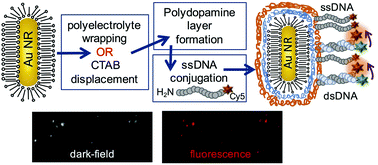
Gold nanorods (NRs) have attracted a great deal of interest for a variety of biomedical and sensing applications. However, developing robust methods for biofunctionalizing NRs has continued to be challenging, especially for NR–DNA conjugates. This is due to the presence of cetyltrimethylammonium bromide (CTAB), which plays an essential role in controlling the anisotropic particle growth. In this article, we systematically explore the growth of a polydopamine (PDA) layer on a range of NR surfaces, comparing different polyelectrolyte and alkanethiol coatings as well as direct CTAB displacement. This revealed that the PDA layer thickness and growth rate is strongly dependent on the underlying nanorod functionalization chemistry and allowed us to establish a preferred route for the creation of stable, non-aggregated suspensions of PDA-coated NRs. The utility of this platform was then demonstrated by self-assembling packed monolayers of single-stranded DNA on the outer surface. Both the surface attachment and bioactivity of the resulting NR–DNA conjugates was then demonstrated by performing bulk solution and single nanoparticle imaging fluorescence measurements.