Molecular-Simulation-Driven Fragment Screening for the Discovery of New CXCL12 Inhibitors
Gerard Martinez-Rosell, Matt J. Harvey, Gianni De Fabritiis
文献索引:10.1021/acs.jcim.7b00625
全文:HTML全文
摘要
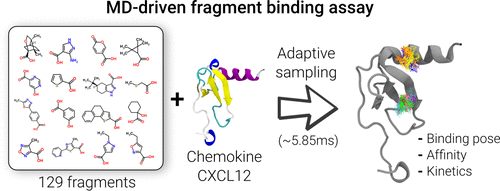
Fragment-based drug discovery (FBDD) has become a mainstream approach in drug design because it allows the reduction of the chemical space and screening libraries while identifying fragments with high protein–ligand efficiency interactions that can later be grown into drug-like leads. In this work, we leverage high-throughput molecular dynamics (MD) simulations to screen a library of 129 fragments for a total of 5.85 ms against the CXCL12 monomer, a chemokine involved in inflammation and diseases such as cancer. Our in silico binding assay was able to recover binding poses, affinities, and kinetics for the selected library and was able to predict 8 mM-affinity fragments with ligand efficiencies higher than 0.3. All of the fragment hits present a similar chemical structure, with a hydrophobic core and a positively charged group, and bind to either sY7 or H1S68 pockets, where they share pharmacophoric properties with experimentally resolved natural binders. This work presents a large-scale screening assay using an exclusive combination of thousands of short MD adaptive simulations analyzed with a Markov state model (MSM) framework.