前往化源商城

Journal of Hazardous Materials 2018-03-28

Homogeneous photocatalytic Fe3+/Fe2+ redox cycle for simultaneous Cr(VI) reduction and organic pollutant oxidation: Roles of hydroxyl radical and degradation intermediates

Dong-hyo Kim, Dongwoo Lee, Damián Monllor-Satoca, Kitae Kim, Woojin Lee, Wonyong Choi

文献索引:10.1016/j.jhazmat.2018.03.055

全文:HTML全文

摘要
10.1016/j.jhazmat.2018.03.055图片

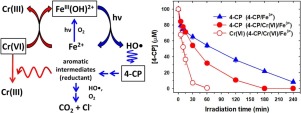
The sustained oxidation of aqueous organic pollutants using hydroxyl radicals (HO radical dot) generated in the UV-irradiated solution of ferric ions was investigated in the presence of Cr(VI). The synergistic effect of simultaneous 4-chlorophenol (4-CP) oxidation and Cr(VI) reduction is explained in terms of the various roles of OH radical, degradation intermediates, and Fe3+/Fe2+ redox cycle. The photolysis of FeIII(OH)2+ generates OH radical which degrades the organic substrate. The reduction of Cr(VI) was inhibited by the OH radical-induced re-oxidation of Cr(III) in the absence of 4-CP. The complete removal of Cr(VI) was achieved only in the presence of phenolic substrates which not only reacts with OH radical (hence inhibiting the reoxidation of Cr(III)) but also generates reducing intermediates which effectively reduce Cr(VI). Fe2+ also converted Cr(VI) to Cr(III) with regenerating Fe3+, which makes the overall process photocatalytic. The photocatalytic activity for the simultaneous removal of 4-CP and Cr(VI) was largely maintained up to five cycles. Such simultaneous and synergic photoactivity was also observed for other phenolic compounds (4-bromophenol, 4-nitrophenol, phenol). The simultaneous and synergic removal of phenolic compounds and Cr(VI) can be enabled through the redox couple of Fe3+/Fe2+ working as a homogeneous photocatalyst.