Solid–Liquid Interface Structure of Muscovite Mica in SrCl2 and BaCl2 Solutions
Stelian Pintea, Wester de Poel, Aryan E. F. de Jong, Roberto Felici, Elias Vlieg
文献索引:10.1021/acs.langmuir.8b00504
全文:HTML全文
摘要
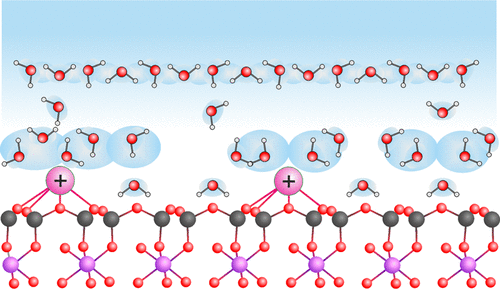
The structure of the solid–liquid interface formed by muscovite mica in contact with two divalent ionic solutions (SrCl2 and BaCl2) is determined using in situ surface X-ray diffraction using both specular and non-specular crystal truncation rods. The 0.5 monolayer of monovalent potassium present at the surface after cleavage is replaced by approximately 0.25 monolayer of divalent ions, closely corresponding to ideal charge compensation within the Stern layer in both cases. The adsorption site of the divalent ions is determined to be in the surface ditrigonal cavities with minor out-of-plane relaxations that are consistent with their ionic radii. The divalent ions are adsorbed in a partly hydrated state (partial solvation sphere). The liquid ordering induced by the presence of the highly ordered crystalline mica is limited to the first 8–10 Å from the topmost crystalline surface layer. These results partly agree with previous studies in terms of interface composition, but there are significant differences regarding the structural details of these interfaces.