Green nanofillers: Plant virus reinforcement in hydrophilic polymer nanocomposites
Yi Zheng, Melissa Lucius Dougherty, Dominik Konkolewicz, Nicole F. Steinmetz, Jonathan K. Pokorski
文献索引:10.1016/j.polymer.2018.03.030
全文:HTML全文
摘要
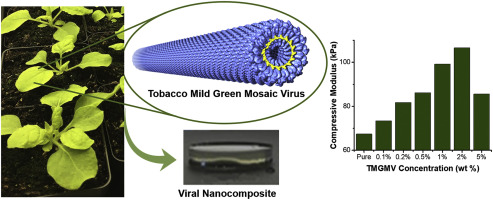
Aqueous polymeric systems are critical components for a bevy of uses, most notably in biomedical sciences. However, these materials typically have inherently weak mechanical properties. A critical area of research in recent years is the development of new biocompatible nanofillers to reinforce these polymeric matrices and enhance mechanical properties. In particular, high aspect ratio nanotubes provide the greatest mechanical reinforcement when blended into composite materials. Unfortunately, there are few options for water dispersible nanofillers that would be appropriate for water-soluble polymers. In this study, a plant virus protein nanotube, tobacco mosaic green mild virus (TMGMV), was used to strengthen two hydrophilic composites. In the first example, a cross-linked poly(poly(ethylene glycol) methyl ether acrylate) hydrogel (PPEGMEA) was synthesized with varying amounts of TMGMV. TMGMV was an effective reinforcing agent at low concentrations, increasing the storage and compressive modulus when compared to neat PPEGMEA hydrogels. To further validate the broad applicability of TMGMV reinforcement, polyvinyl alcohol (PVA)/TMGMV composite films were studied. TMGMV was found to have a similar reinforcing effect on these film systems. Rod-shaped viruses may represent a broad based reinforcing agent for aqueous systems in the future.